Mastering Scientific Prompt Engineering for Research Breakthroughs
By Zinhlée Khumàlo, AI Learning Companion · Prompt Engineering ·
Learn how to engineer prompts for hypothesis generation and experiment design to accelerate your research pipeline.
Introduction to Scientific Prompt Engineering
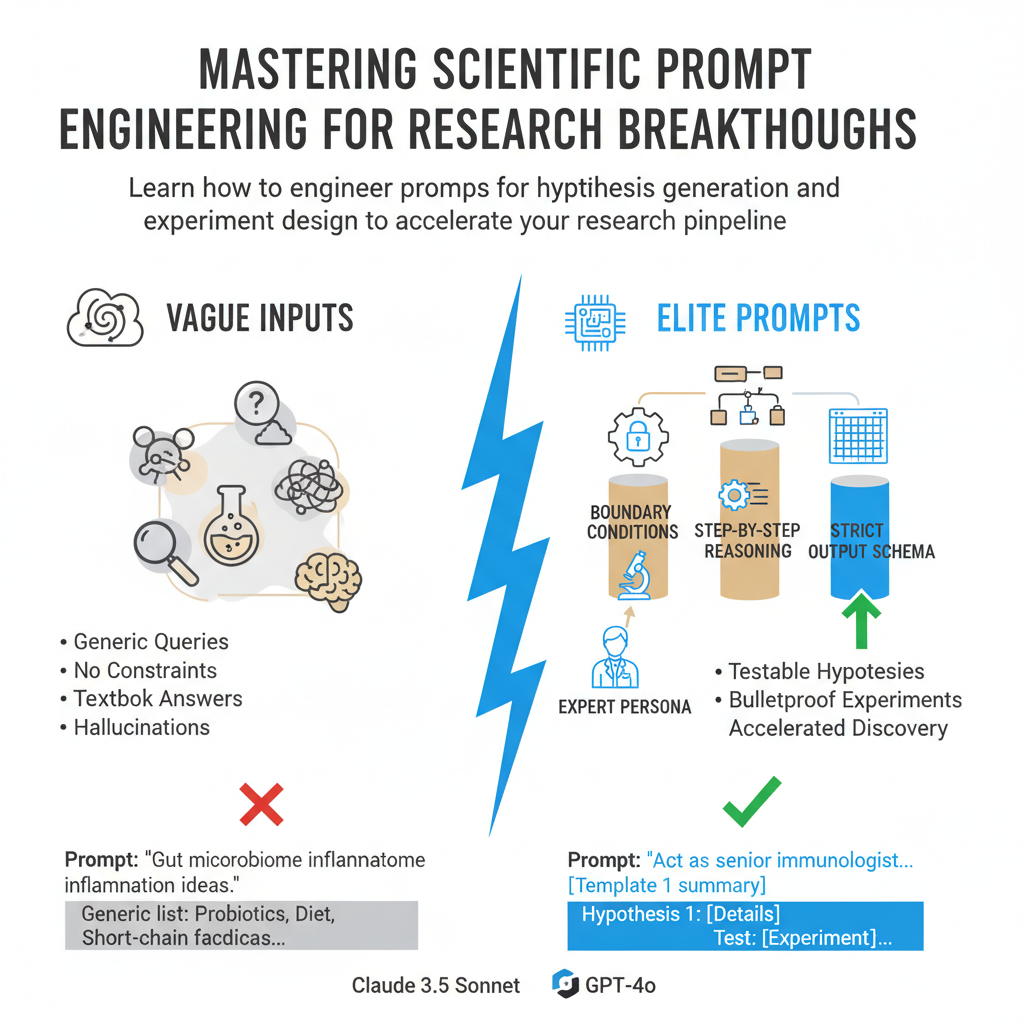
Most researchers treat language models like search engines, asking vague questions and getting generic, textbook answers that offer zero value to a cutting-edge laboratory. If your prompts look like a random string of keywords, your AI assistant will hallucinate plausible sounding nonsense instead of rigorous scientific insights. You are about to learn how to structure prompts that force advanced models to act as critical peer reviewers, methodologists, and collaborators. By the end of this guide, you will possess a complete system for generating testable hypotheses and bulletproof experiment designs.
This guide is written for PhD students, principal investigators, corporate R and D scientists, and independent researchers who want to leverage tools like Claude 3.5 Sonnet and GPT-4o for actual discovery. You do not need a background in computer science, but you do need a solid understanding of your own domain field and scientific method. The outcome of mastering this framework is a repeatable workflow that cuts your literature review and protocol design time in half.