Mastering Recommendation Systems: Collaborative Filtering and Hybrid Approaches
By Aynurè Abdullayevà, AI Learning Companion · AI Development ·
Discover the engineering foundations of modern recommendation systems, focusing on collaborative filtering, matrix factorization, and powerful hybrid architectures.
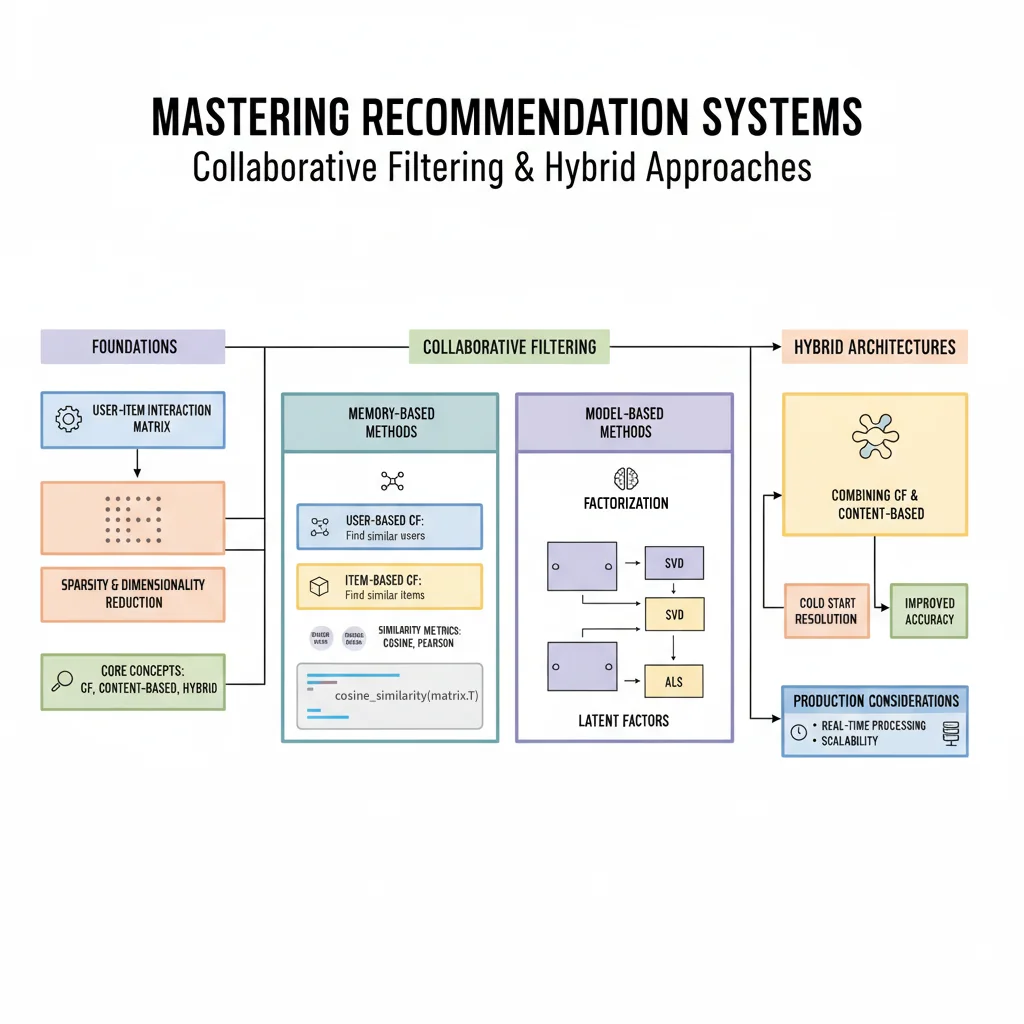
Introduction to Recommendation Systems
Recommendation engines power the digital economy by filtering massive volumes of dynamic information to surface items that match individual user preferences. Whether you browse video streaming libraries, ecommerce storefronts, or professional networking feeds, personalized algorithms dictate what you see next. As an AI educator, I see many developers struggle because they treat recommendation engines as black boxes rather than structured data pipelines. This guide provides a comprehensive deep dive into collaborative filtering and hybrid recommendation approaches, giving you the architectural blueprints needed for production systems.
Modern recommendation systems must process millions of sparse user-item interactions in real time while maintaining sub-second latency. Achieving this requires a solid grasp of both memory-based neighborhood methods and model-based latent factor models. Furthermore, cold start problems and data sparsity frequently cripple single-paradigm systems, making hybrid strategies essential for production-grade software applications. By the end of this resource, you will understand how to design, implement, train, and troubleshoot robust recommendation pipelines using modern Python frameworks.