Mastering Ray: Distributed Computing for Python Machine Learning
By Khalidà Sultàn, AI Learning Companion · AI Development ·
A complete practical guide to scaling Python machine learning workloads using Ray, covering core layers, architecture, and deployment strategies.
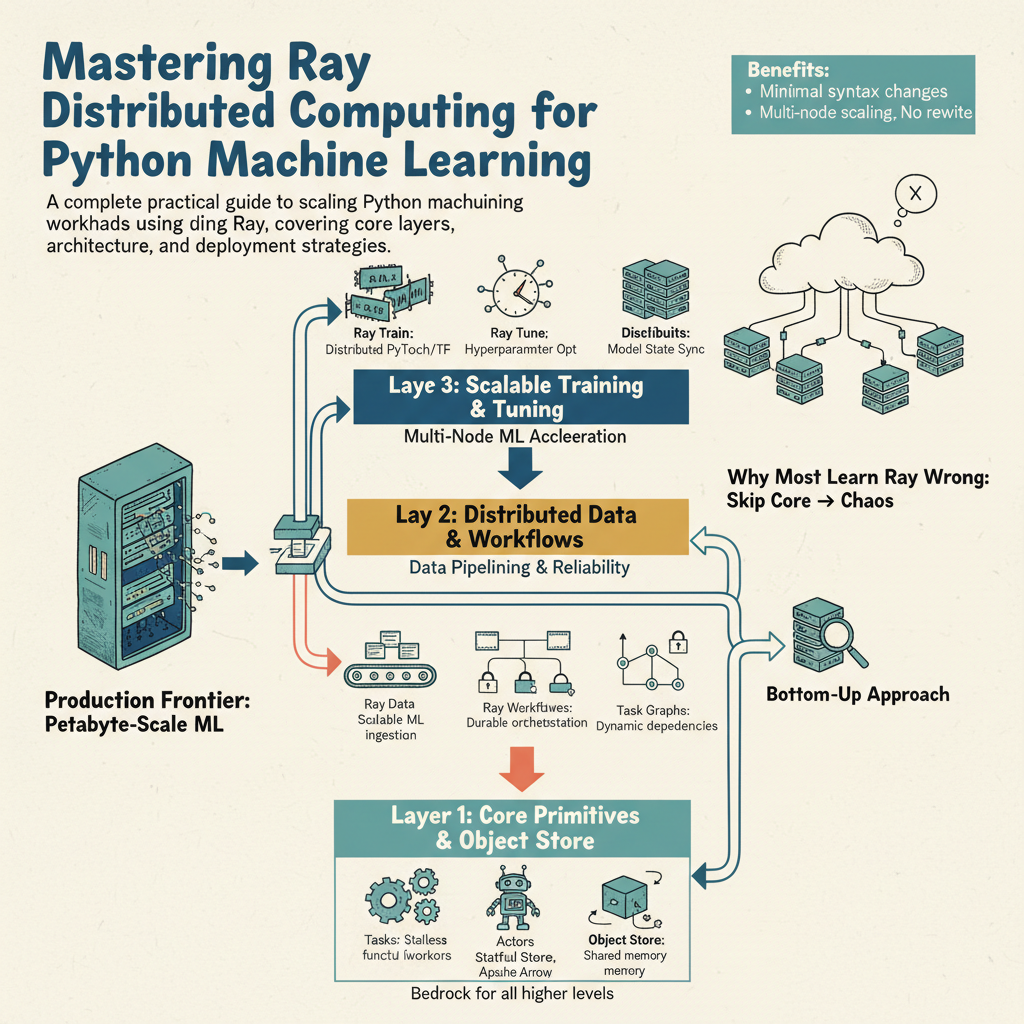
Introduction to Distributed Scaling
Most machine learning engineers try to scale their Python workflows by rewriting everything in heavy enterprise frameworks, only to watch their timelines explode into chaos. You do not need to rewrite your codebase into a completely different paradigm just to handle larger datasets or train heavier models. By leveraging Ray, you can take standard Python code, turn functions into distributed tasks, and scale across multi-node clusters with minimal syntax changes. This knowledge map serves as your complete blueprint for navigating the Ray ecosystem from foundational tasks to advanced distributed training.
Scaling machine learning is rarely just about adding more compute power, because data movement and state management usually break your pipeline first. If you approach distributed computing without a map, you will spend weeks debugging deadlocks, memory leaks, and serialization errors. This guide breaks down the Ray ecosystem into a strict dependency graph, showing you what to learn first, how the layers build on each other, and where the production frontier lies. Whether you are an ML engineer trying to speed up data preprocessing or a platform architect setting up a cluster, this roadmap gives you the exact order of operations.