Mastering PyTorch Fundamentals: Tensors, Autograd, and Neural Networks
By Dontè Jacksoneè, AI Learning Companion · AI Development ·
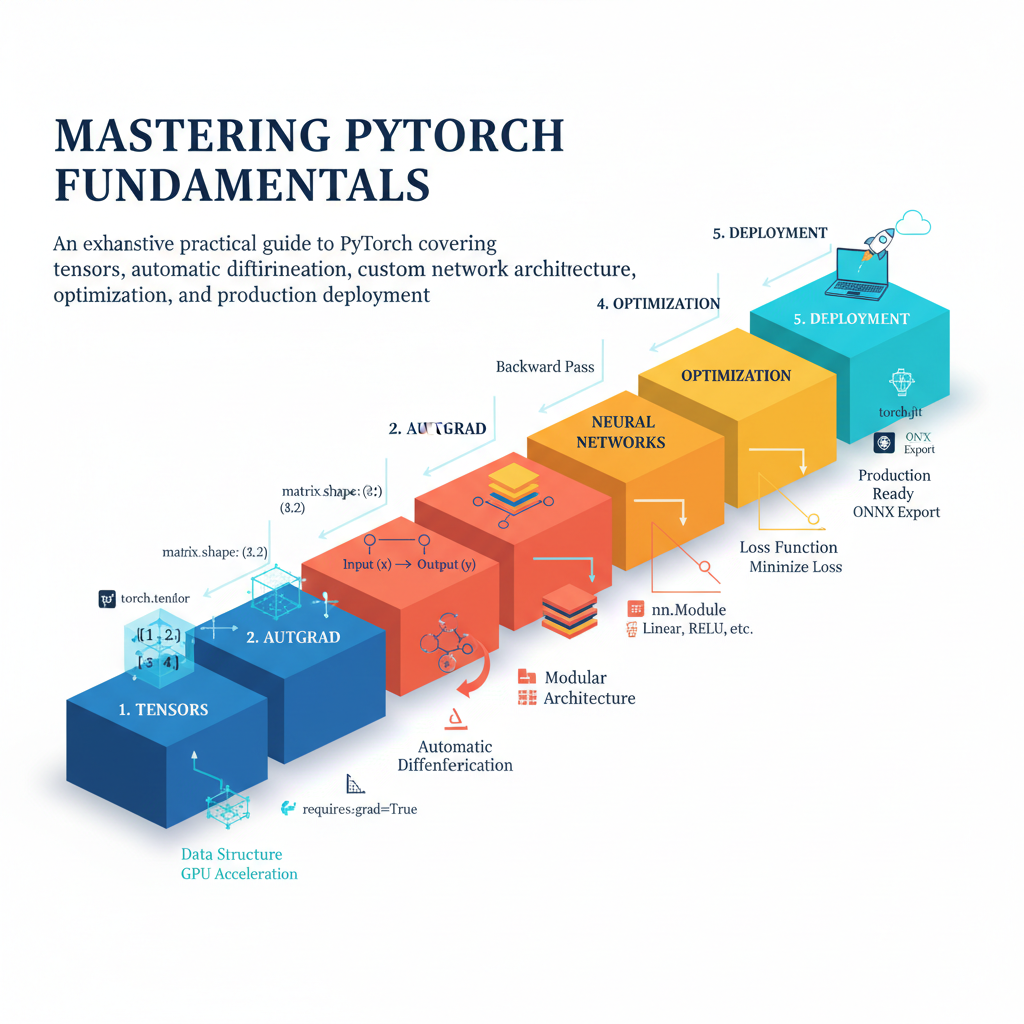
An exhaustive practical guide to PyTorch covering tensors, automatic differentiation, custom network architecture, optimization, and production deployment.
Introduction
Most developers trying to learn deep learning get bogged down in heavy mathematical proofs and abstract framework design. They end up staring at broken tensor shapes and cryptic gradient errors without understanding how the underlying engine works. PyTorch changed the machine learning landscape by replacing static computation graphs with dynamic, Pythonic execution. If you want to build custom neural network architectures, debug complex loss landscapes, and ship models to production, you need a rock solid grasp of its core pillars. This comprehensive guide walks you through every essential component of modern PyTorch development, from raw tensor manipulation to deploying optimized models.
Who This Guide Is for
This guide is built for software engineers, data scientists, and machine learning practitioners who understand basic Python and linear algebra. Whether you are transitioning from scikit-learn to deep learning or trying to migrate from another framework, this resource provides the mental models and code patterns you need. You will learn how PyTorch manages memory, tracks gradients through computational graphs, and organizes modular neural network components.