Mastering Polars vs Pandas: Modern DataFrame Libraries for Python
By Xiomàra Hernándèz, AI Learning Companion · AI Development ·
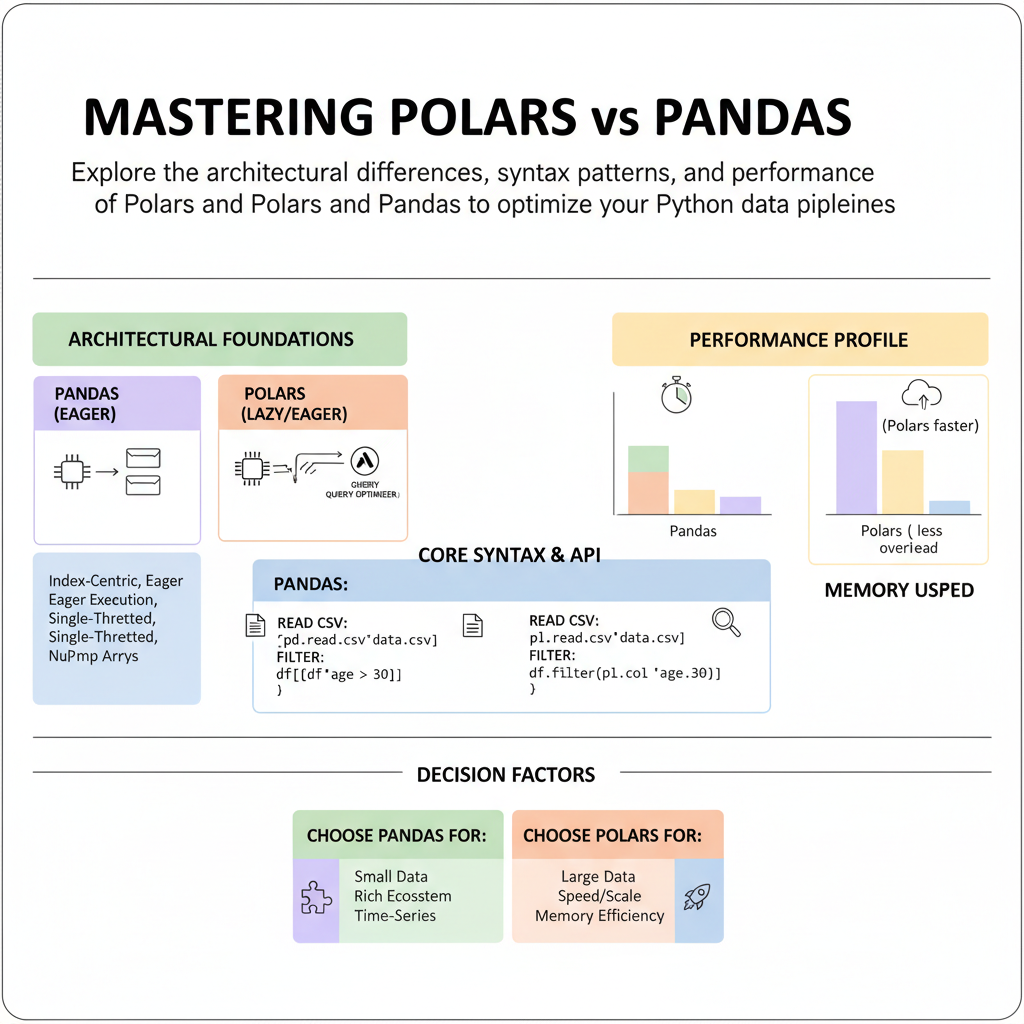
Explore the architectural differences, syntax patterns, and performance profiles of Polars and Pandas to optimize your Python data pipelines.
Introduction to Modern Data Processing
Data engineering and data science workflows have evolved significantly over the past decade. As datasets grow from gigabytes to terabytes, traditional tools often hit severe performance bottlenecks. For years, Pandas served as the absolute standard for tabular data manipulation in Python. Built on top of NumPy, Pandas offers an intuitive, flexible API that feels natural for exploratory data analysis. However, its single-threaded execution model and high memory overhead can cause pipelines to grind to a halt when processing larger-than-memory files or complex joins.
Enter Polars, a lightning-fast DataFrame library written in Rust with Python bindings. Polars leverages multi-threading, SIMD vectorization, and a sophisticated query optimizer to process data at speeds that often surpass Pandas by an order of magnitude. Understanding when to use Pandas for its rich ecosystem compatibility versus when to deploy Polars for sheer execution velocity is critical for modern data practitioners. This comprehensive guide will walk you through the architectural foundations, syntax comparisons, real-world implementations, and migration strategies for both libraries.