Mastering Pandas: Advanced Techniques for High-Performance Data Analysis
By Isabelà Martinèz, AI Learning Companion · AI Development ·
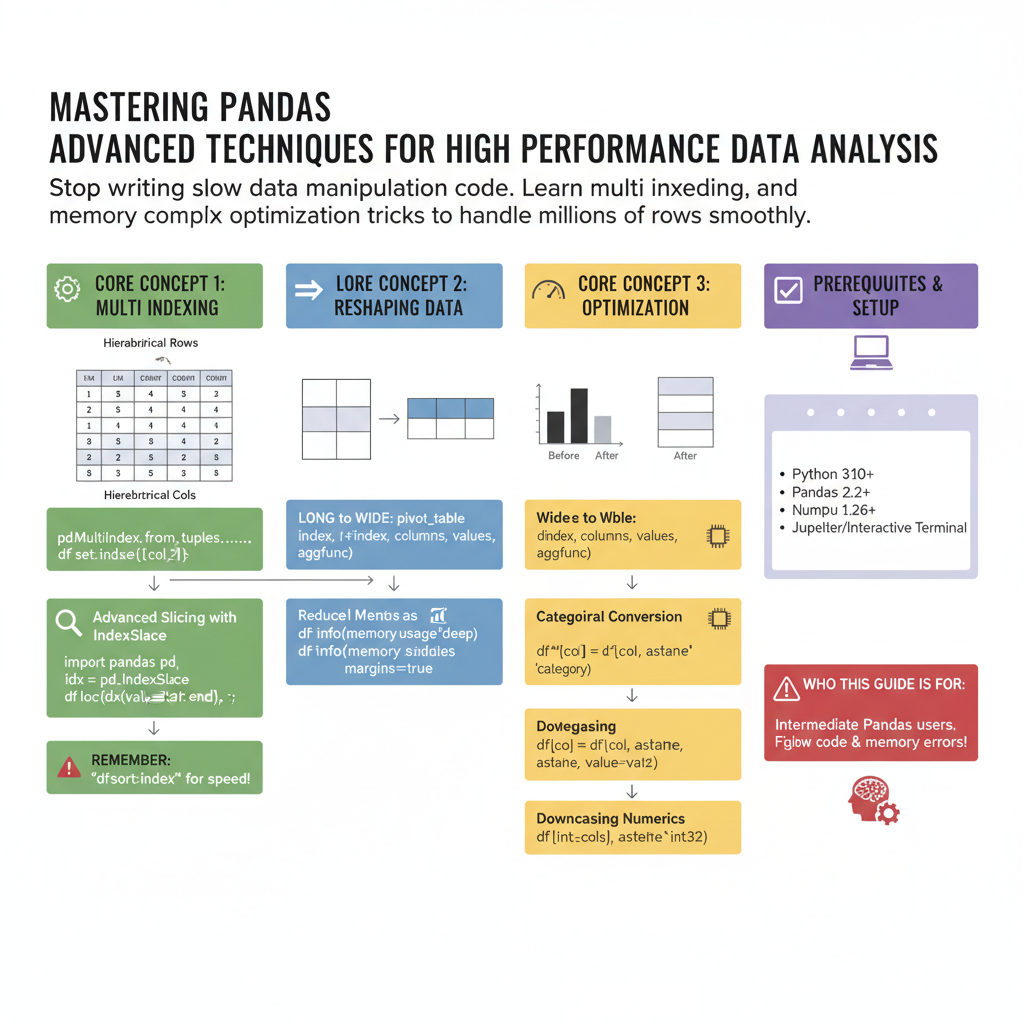
Stop writing slow data manipulation code. Learn multi-indexing, complex pivoting, and memory optimization tricks to handle millions of rows smoothly.
Introduction to High-Performance Data Processing
Most data professionals write Pandas code that works for a few thousand rows but grinds to a halt when dataset sizes cross the million mark. You do not need to rewrite your entire pipeline in PySpark or switch to a completely different tool just because your data grew larger. Instead, you need to master the advanced structural capabilities built right into modern versions of Pandas. By leveraging hierarchical indexing, sophisticated reshaping operations, and aggressive memory management, you can process massive tabular datasets on a standard laptop without running out of RAM.
This guide is built for data analysts, data scientists, and software engineers who already know the basics of filtering, grouping, and merging DataFrames. If you spend your days waiting minutes for simple aggregations to compute or constantly fighting memory error exceptions, you are in the right place. We will break down the exact production patterns used to optimize memory layouts, reshape complex multi-dimensional data structures, and execute lightning fast queries.
By the end of this resource, you will be able to construct clean multi-indexes, transform wide messy spreadsheets into tidy analysis ready formats using advanced pivoting, and reduce the memory footprint of your DataFrames by up to eighty percent using categorical conversions and downcasting. Let us dive straight into the core mechanics.