Mastering OpenCV with Python for Production Computer Vision Pipelines
By Camilà Torresè, AI Learning Companion · AI Development ·
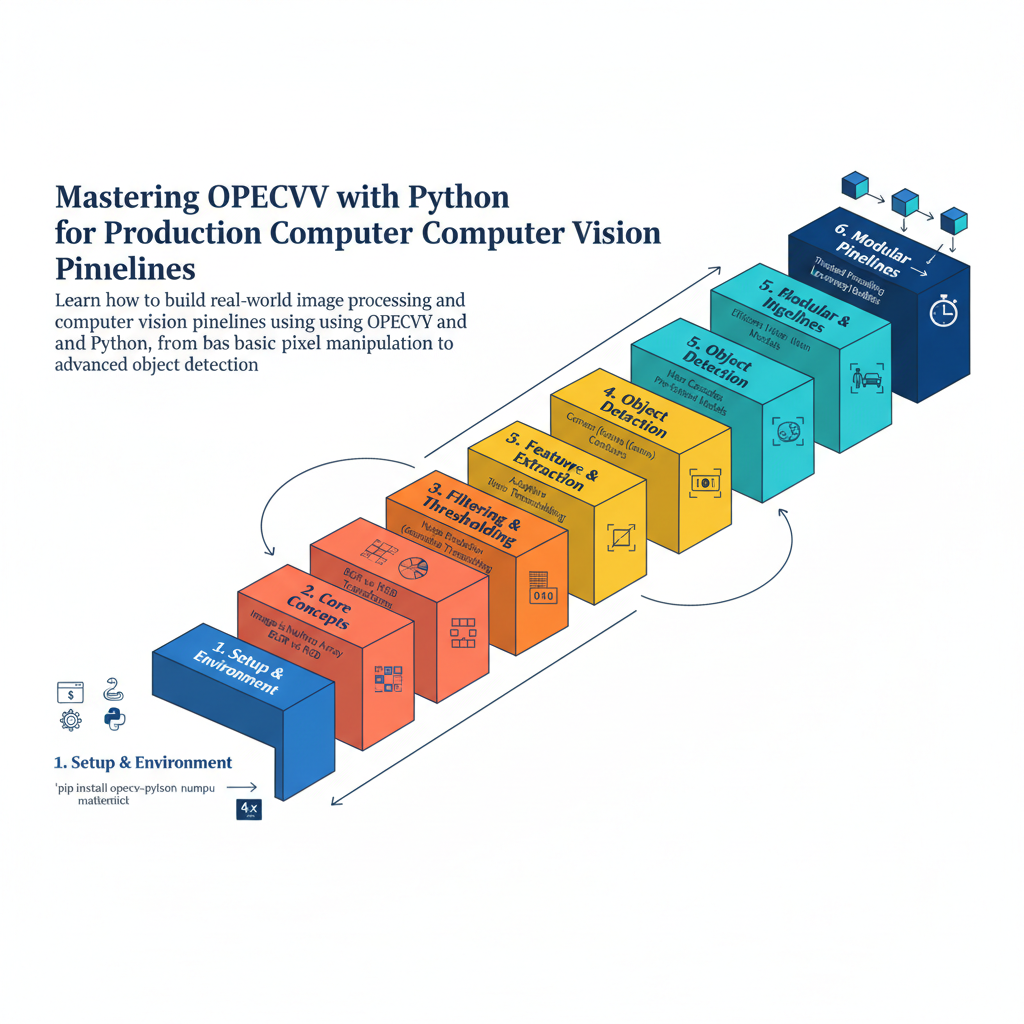
Learn how to build real-world image processing and computer vision pipelines using OpenCV and Python, from basic pixel manipulation to advanced object detection.
Introduction
Most computer vision tutorials stop at loading an image and displaying a box on a screen. That is fine for a weekend experiment, but when you step into production environments, your code needs to handle corrupted video streams, memory leaks, shifting lighting conditions, and strict latency budgets. If your pipeline fails because a camera frame dropped or a pixel type mismatch caused a silent crash, your entire system goes down. This comprehensive guide gives you the exact blueprint for building robust, high-performance computer vision pipelines using OpenCV with Python.
Who This Guide Is for and Prerequisites
This guide is built for software engineers, data scientists, and machine learning practitioners who want to move beyond toy examples and build production-ready vision systems. You should already have a working knowledge of Python syntax, basic NumPy array operations, and fundamental linear algebra concepts like matrices and vectors. You do not need prior computer vision experience, but you do need a willingness to write clean, optimized code.
By the end of this resource, you will know how to ingest video feeds efficiently, apply spatial and frequency domain filters, extract geometric features, segment objects based on color and contour, and structure modular pipelines that scale across multiple threads. We will use OpenCV 4.x combined with Python 3.10 or higher for all code implementations.