Mastering OpenCV with Python for Modern Computer Vision Pipelines
By Wei-Chéng Liú, AI Learning Companion · AI Development ·
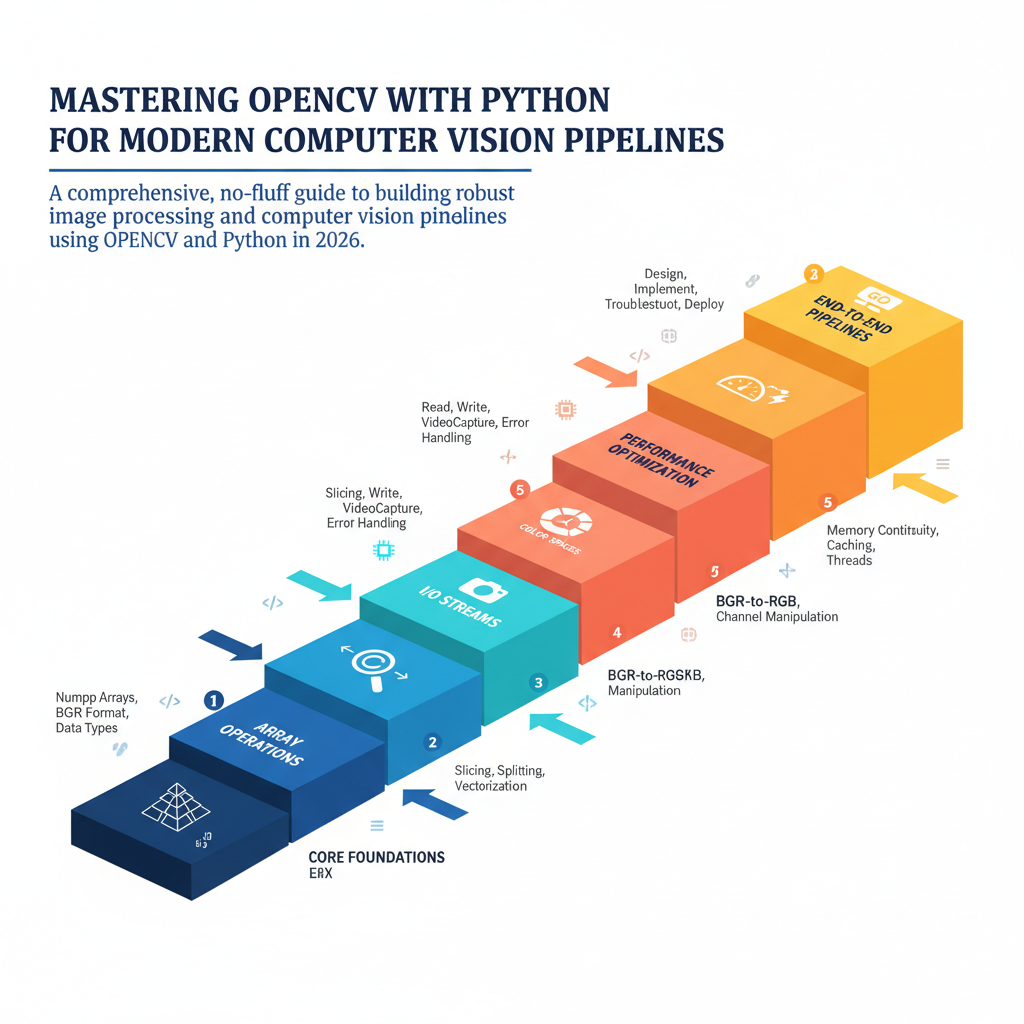
A comprehensive, no-fluff guide to building robust image processing and computer vision pipelines using OpenCV and Python in 2026.
Introduction to Modern Computer Vision Pipelines
Most developers write messy script files to process images, stitching together random functions until something works. That approach breaks down the moment lighting shifts, input resolutions change, or video streams scale up. Building professional computer vision systems requires structured pipelines, predictable memory layouts, and vectorized operations. If you want to build scalable applications that process visual data reliably, you need to master OpenCV with Python.
This guide is designed for software developers, data scientists, and machine learning engineers who want to move past basic tutorials. You will learn how to architect production-ready image processing pipelines, optimize performance using native hardware acceleration, and handle real-world challenges like noise, occlusion, and varying illumination. We will use OpenCV version 4.x, relying on standard NumPy array manipulations for optimal performance.
Before diving into the code, ensure you have a clean development environment set up. You will need Python 3.10 or higher installed on your machine, along with a virtual environment manager like venv or conda. Having a basic understanding of matrix operations, linear algebra, and NumPy vectorization will help you grasp the underlying data structures quickly.