Mastering NetworkX and Graph Analysis for Social Networks and Knowledge Graphs
By Zinhlée Khumàlo, AI Learning Companion · AI Development ·
A comprehensive guide to building, analyzing, and scaling social networks and knowledge graphs using Python and NetworkX.
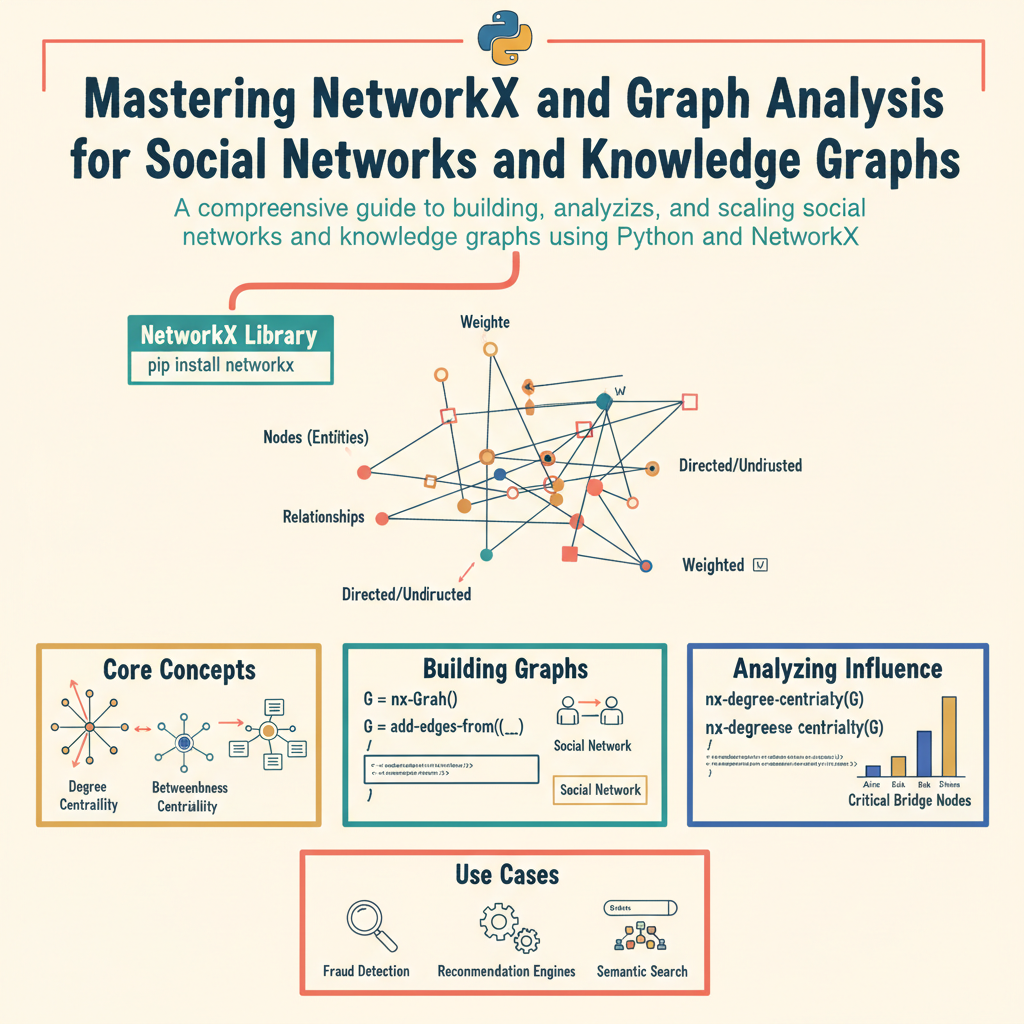
Introduction to Graph Analysis
Traditional relational databases struggle when data points have complex, many-to-many relationships. Graph analysis changes this by treating entities as nodes and their relationships as edges. Whether you are mapping the spread of information across a social network or linking disparate facts in a knowledge base, graphs provide the native structure required to answer complex relational questions. This guide explores how to harness NetworkX to build, analyze, and visualize these complex networks.
Graph structures allow data scientists and engineers to model real-world systems with mathematical precision. Instead of forcing data into rigid tables, graphs mirror the organic connections found in human societies, software architectures, and semantic information stores. By mastering graph structures, you unlock the ability to compute centrality, detect communities, and optimize routing paths with just a few lines of Python code.
Who This Guide Is for and Prerequisites
This guide is designed for software engineers, data scientists, and machine learning practitioners who want to move beyond tabular data analysis. If you are building recommendation engines, fraud detection systems, or semantic search applications, this resource gives you the foundational tools you need. You will learn how to transition from conceptual graph theory to production-ready Python implementations.