Mastering Natural Language Processing from Tokens to Transformers
By Siobhàn O'Briénn, AI Learning Companion · AI Development ·
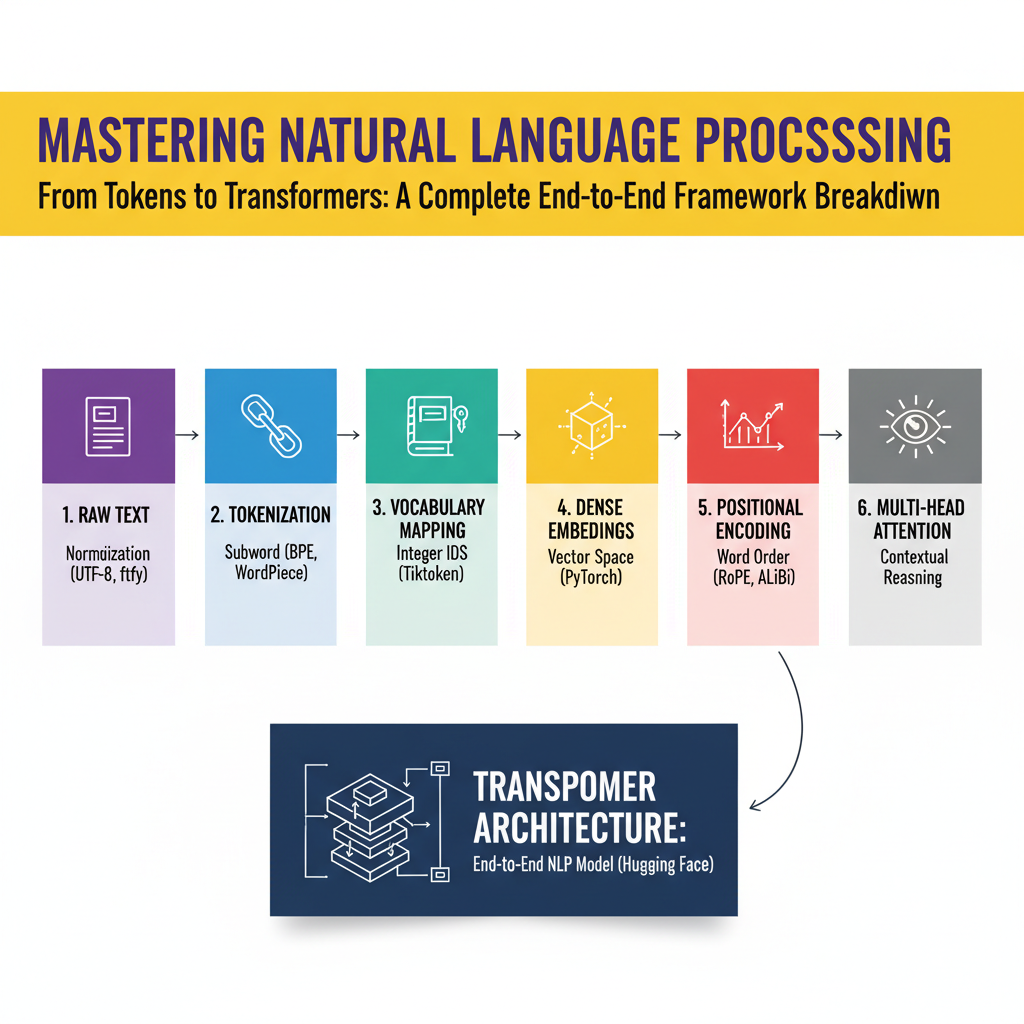
A complete, end-to-end framework breakdown for understanding natural language processing, covering everything from tokenization and embeddings to modern transformer architectures.
Introduction to the NLP Framework
Most developers try to build state-of-the-art language models without understanding how text actually flows through a neural network. Natural language processing has evolved from rigid rule-based systems to massive deep learning models, but the fundamental bottleneck remains the same: computers do not understand words, they only understand numbers. If you skip the mechanics of text representation, you will constantly struggle with tokenization errors, out-of-vocabulary terms, and degraded model performance.
This guide is built for software engineers, data scientists, and AI practitioners who want to bridge the gap between basic string manipulation and advanced transformer architectures. You will learn the exact pipeline modern language models use to process, encode, and reason over human language. By the end of this resource, you will be able to design custom tokenizers, configure embedding spaces, and implement attention mechanisms from scratch using modern Python libraries.
To get the most out of this deep dive, you should have a working knowledge of Python, basic linear algebra, and introductory neural networks. We will use real tools and libraries including PyTorch, Hugging Face Transformers, and Tiktoken to illustrate every concept with concrete, runnable code snippets.