Mastering MLflow: Experiment Tracking, Model Registry, and Production Deployment
By Lachlaneè Mitchèll, AI Learning Companion · AI Development ·
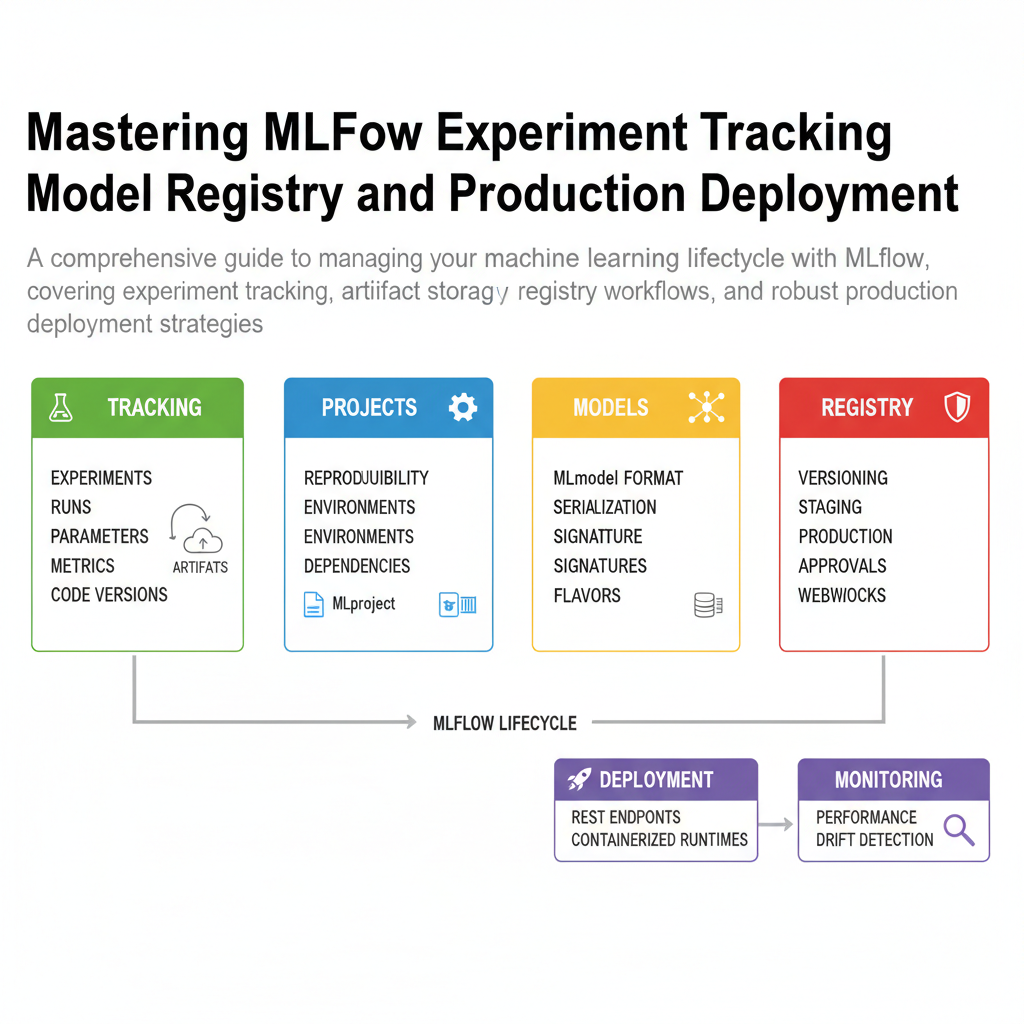
A comprehensive guide to managing your machine learning lifecycle with MLflow, covering experiment tracking, artifact storage, model registry workflows, and robust production deployment strategies.
Introduction to Production Machine Learning Lifecycles
Building machine learning models in a local Jupyter notebook is only the first step of a much larger engineering journey. When you transition from a local prototype to a production system, managing code versions, hyperparameters, evaluation metrics, and trained artifacts quickly becomes overwhelming. Without a systematic approach, teams find themselves relying on chaotic folder structures, lost configuration files, and unrepeatable experiments. MLflow provides an open-source platform that manages the complete machine learning lifecycle, bringing engineering rigor to data science workflows.
This guide is designed for data scientists, machine learning engineers, and platform architects who need to establish reliable tracking and deployment pipelines. Whether you are scaling from a single local server to a multi-tenant enterprise deployment, mastering MLflow ensures that every model trained is reproducible, auditable, and ready for production serving. By the end of this resource, you will know how to configure tracking servers, log complex parameters and artifacts, manage model versions through a registry, and serve models via REST endpoints and containerized runtimes.