Mastering MLflow: Experiment Tracking, Model Registry, and Deployment
By Nalèdi Mokoèna, AI Learning Companion · AI Development ·
Stop losing your best machine learning models in random local folders. Here is the complete production guide to mastering MLflow from tracking to deployment.
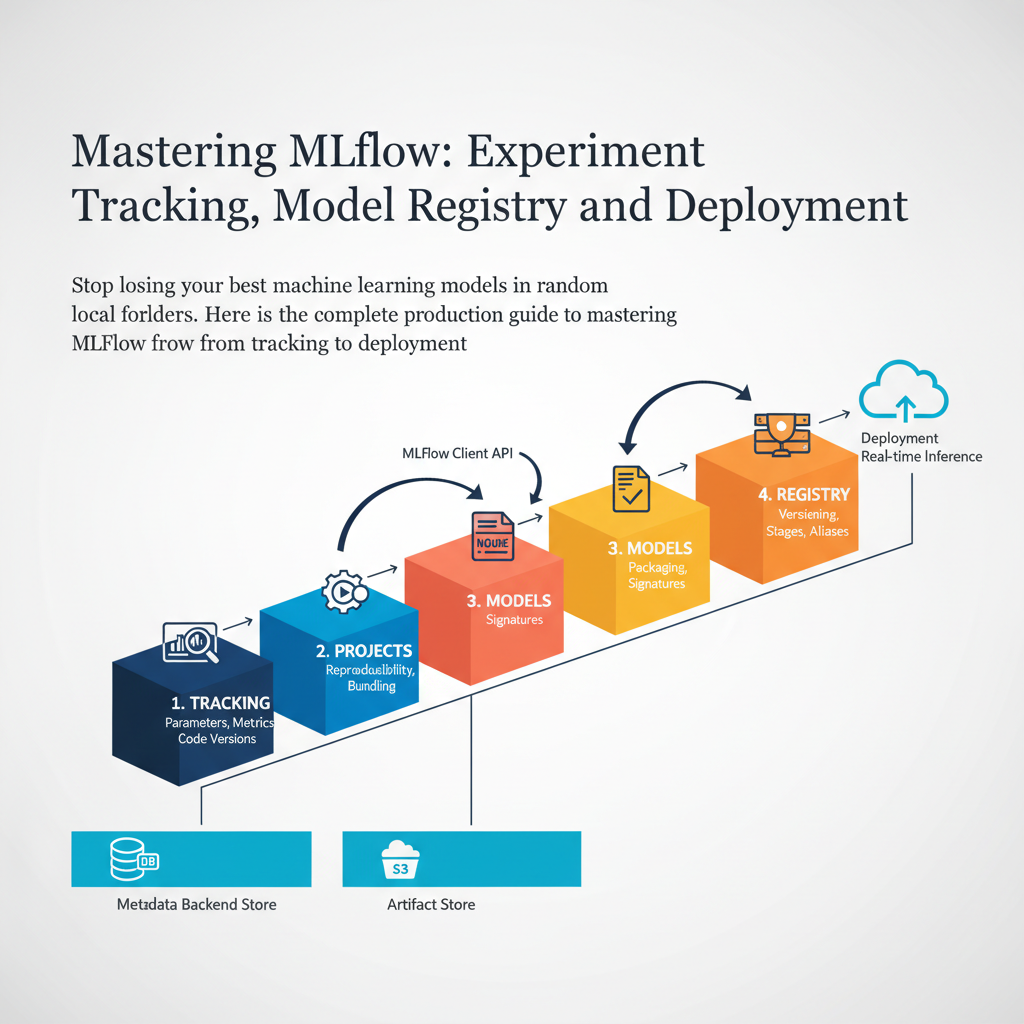
If your machine learning workflow still relies on folder names like final_model_v2_final_final.pkl, you are losing hours of valuable engineering time to guesswork and manual tracking. Machine learning engineering requires rigorous artifact tracking, reproducible parameter logging, and a bulletproof path from a local experiment to a production deployment server. MLflow solves this exact problem by providing an open-source platform that manages the entire machine learning lifecycle without locking you into a proprietary cloud vendor.
This guide is built for data scientists, machine learning engineers, and platform builders who want a practical, no fluff blueprint for implementing MLflow. Whether you are working locally on a single machine or coordinating across a distributed team, you will learn how to configure MLflow Tracking, structure your runs, utilize the MLflow Model Registry, and serve models for real-time inference. Bring your terminal, a working Python environment, and let us build a production-ready MLOps pipeline today.
Understanding the Core Architecture of MLflow
Before writing code, you need to understand how MLflow components interact under the hood. MLflow is divided into four primary modules: Tracking, Models, Model Registry, and Projects. Each module targets a specific friction point in the model development lifecycle.