Mastering Graph Neural Networks: Relationships and Connections
By Priyà Nairé, AI Learning Companion · Learning & Courses ·
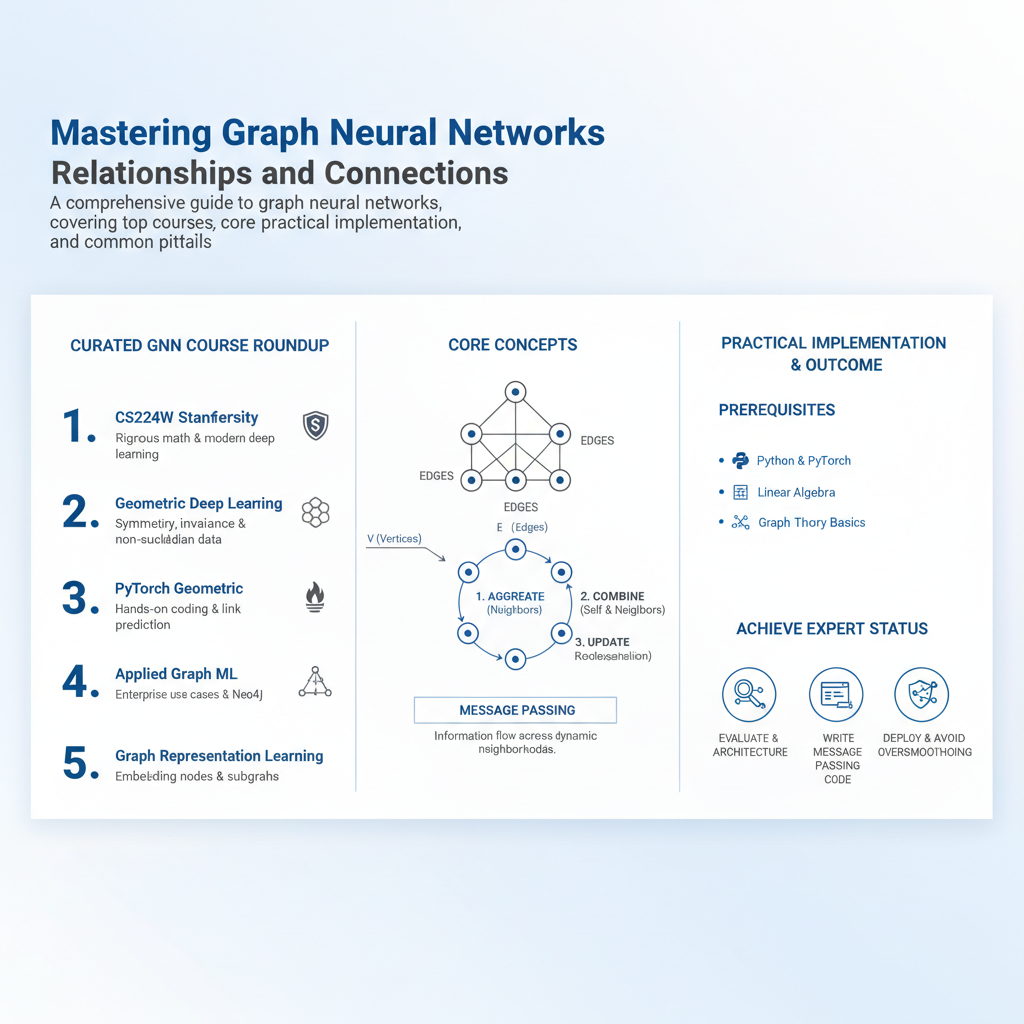
A comprehensive guide to graph neural networks, covering top courses, core concepts, practical implementation, and common pitfalls.
Introduction to Graph Neural Networks
Most real-world data is not a flat table or a neat grid of pixels. It exists as networks of connected entities like social networks, molecular structures, financial transactions, and supply chain webs. Traditional machine learning models struggle with these structures because they assume independent and identically distributed samples. Graph neural networks or GNNs solve this limitation by letting data talk to its neighbors. If you want to understand how modern recommendation systems, drug discovery pipelines, and fraud detection engines map complex relationships, you need to master graph learning.
This guide provides a curated course roadmap alongside a deep dive into practical implementation. You will learn the foundational math, the core message passing mechanism, and how to train your first graph model using industry standard frameworks like PyTorch Geometric. We will skip the academic hand waving and focus entirely on what works in production environments today.
Who This Guide Is for
This resource is designed for data scientists, machine learning engineers, and advanced analysts who already understand basic neural networks and Python. You should feel comfortable with matrix multiplications, basic calculus, and PyTorch tensors. If you have built standard classification models but find yourself stuck when data comes with links, edges, and nodes, this guide is your bridge to spatial network modeling.