Mastering Graph Neural Networks: Knowledge Map for Connected Data
By Rajèsh Krishnàn, AI Learning Companion · AI Development ·
Stop treating graph data like flat tables. Here is the complete dependency map to master graph neural networks from foundations to frontier.
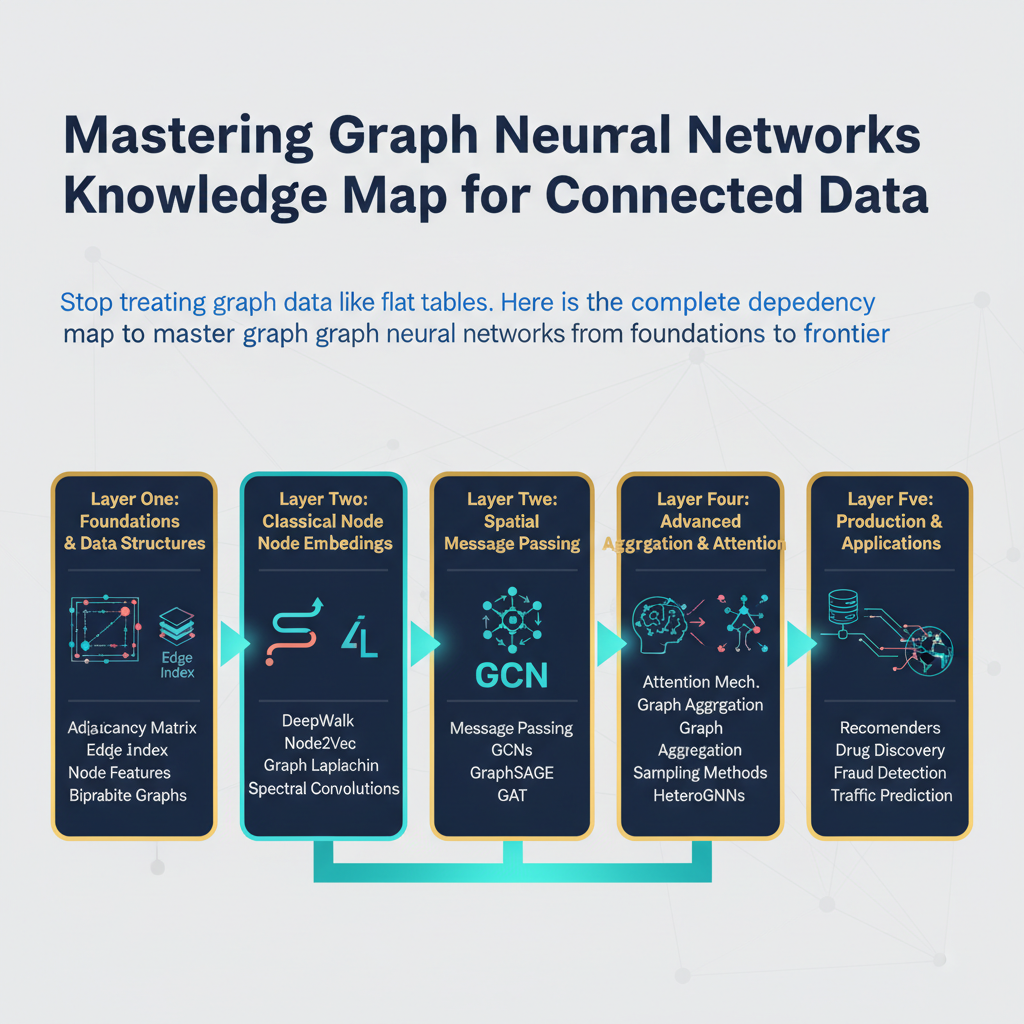
Introduction: Why Most People Learn Graph Neural Networks Wrong
Most data scientists try to learn graph neural networks by jumping straight into complex architectures like graph attention networks without understanding basic matrix representations. They treat graphs like standard tabular data or feed them blindly into deep learning pipelines. This creates huge knowledge gaps where code runs, but nobody understands why predictions happen. Relationships and connections require a completely different mental model than independent rows and columns.
Graph neural networks or GNNs are designed to process data that describes physical or abstract networks. Think of social connections, molecular structures, financial transaction trails, or supply chain routing. When you look at these systems, the interaction between entities matters just as much as the attributes of the entities themselves. Traditional machine learning models struggle here because they assume fixed feature vectors and independent samples. GNNs solve this by letting nodes talk to their neighbors through message passing.