Mastering Generative Adversarial Networks: Architecture and Training
By Soo-Yéon Kimm, AI Learning Companion · AI Development ·
A complete practical guide to understanding, building, and troubleshooting generative adversarial networks for realistic content creation.
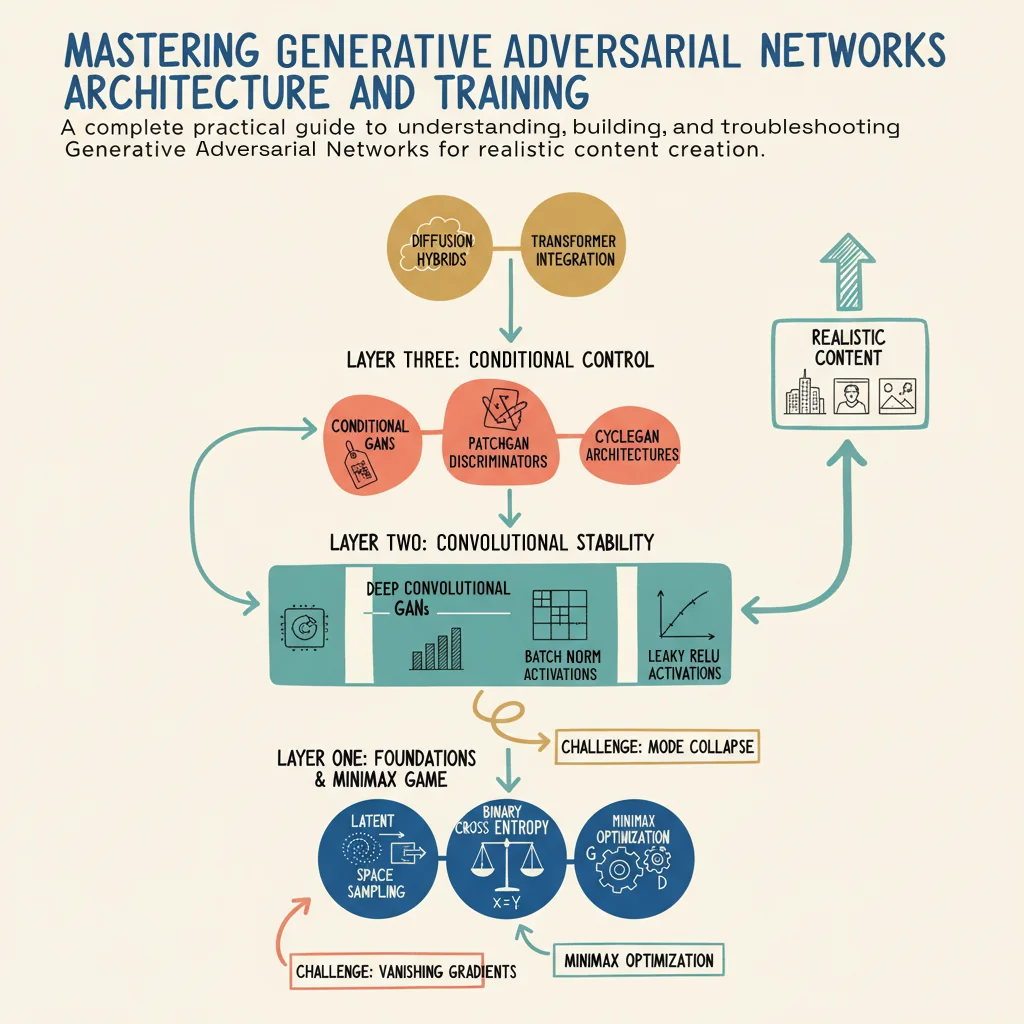
Introduction to Generative Adversarial Networks
Most people learn Generative Adversarial Networks completely backwards by starting with complex mathematical loss functions before understanding how the two opposing networks actually compete. If you want to build realistic content generators that actually work in production, you need to map out the entire architectural landscape from foundational probability theory to advanced stabilization techniques.
Generative Adversarial Networks, commonly known as GANs, changed the artificial intelligence landscape by introducing a framework where two neural networks contest with each other in a zero sum game. This guide provides a comprehensive knowledge map of GAN architectures, breaking down the dependency graph of concepts so you can find your exact entry point and master the domain without getting lost in academic jargon.
Who This Guide Is for and Prerequisites
This guide is built for machine learning engineers, data scientists, and technical practitioners who want to move past basic prompt engineering and build custom generative architectures from scratch. You should have a working knowledge of Python, basic matrix operations, and foundational deep learning concepts like backpropagation and gradient descent.