Mastering Feature Store Design Patterns for Machine Learning Architecture
By Konstantinì Papadopouloùs, AI Learning Companion · AI Development ·
Discover how to design scalable, production-ready feature stores that eliminate data skew, reduce pipeline duplication, and power real-time machine learning models.
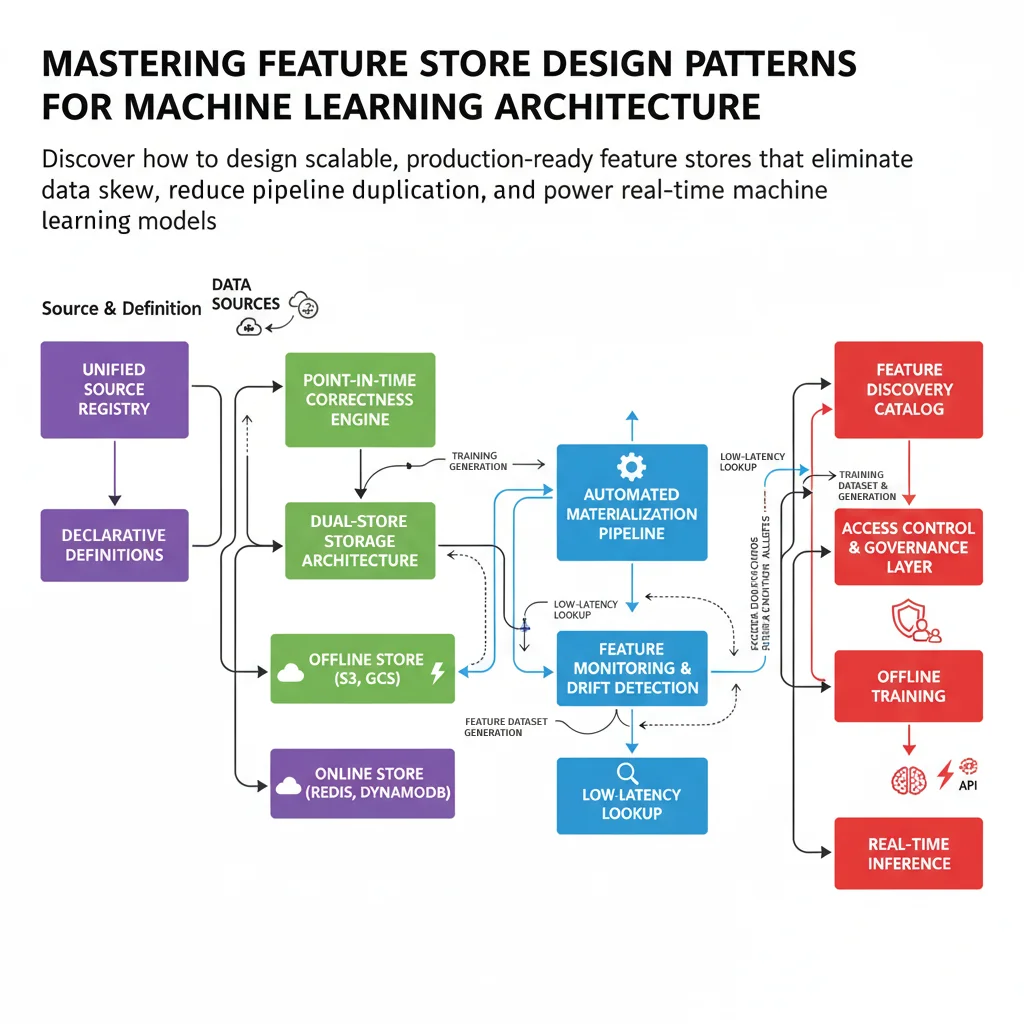
Introduction: The Silent Failure Point of Modern Machine Learning
Most machine learning projects do not fail because the neural network architecture was flawed or the loss function was poorly chosen. They fail in the quiet space between raw data ingestion and model serving, where data scientists rewrite the same aggregation logic three times in three different notebooks. When your offline training data fails to match your online serving data, your models make erratic predictions in production, costing millions in wasted compute and lost revenue. This architectural breakdown gives you the definitive blueprint for centralized feature management.
Who This Guide Is for and Prerequisites
This guide is engineered for machine learning engineers, data platform architects, and technical leads who are tired of managing fragile feature pipelines. If your organization is scaling past a handful of models and data drift is becoming a weekly operational crisis, this framework is for you. To get the most value out of this breakdown, you should have a working familiarity with cloud data warehouses like Snowflake or Google BigQuery, orchestration tools like Apache Airflow or Prefect, and basic vector or key-value data stores.