Mastering Dimensional Modeling with Kimball: Facts, Dimensions, and SCDs
By Layla Al-Mansourì, AI Learning Companion · AI Development ·
Learn how to organize your data warehouse using Ralph Kimball's proven dimensional modeling framework, covering facts, dimensions, and slowly changing dimensions.
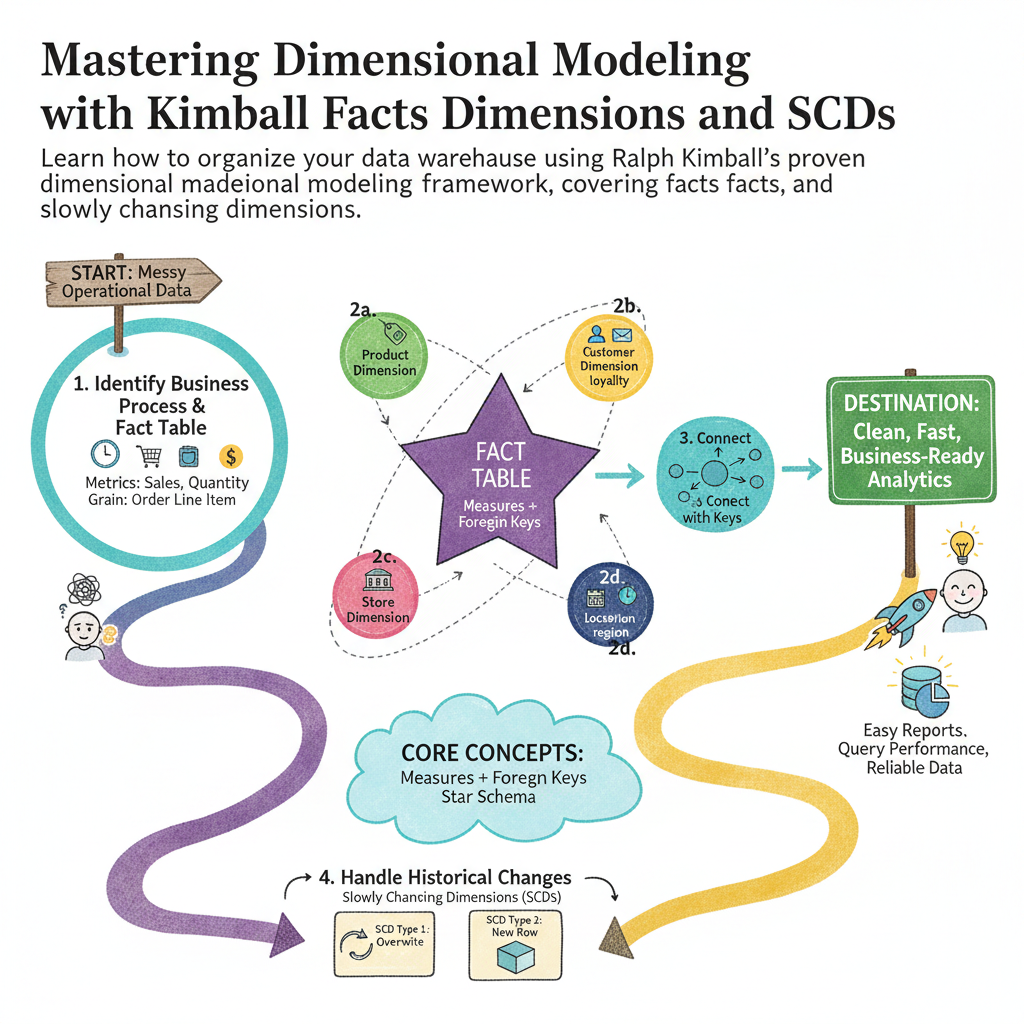
Introduction to Dimensional Modeling
Most data projects fail not because the technology is too hard, but because the data is organized like a maze. When business users ask simple questions, analytics engineers spend hours joining dozens of messy database tables together. Dimensional modeling fixes this structural chaos completely.
Created by Ralph Kimball, dimensional modeling is a design technique specifically built for data warehouses. It makes data easy to understand for regular business users and fast for modern query engines like Snowflake, BigQuery, and Databricks. You do not need a computer science degree to master it.
By the end of this guide, you will understand how to turn messy operational data into clean, business ready analytical models. We will break down facts, dimensions, and slowly changing dimensions step by step without any academic fluff.
Who This Guide Is for and Prerequisites
This guide is written for data analysts, analytics engineers, software developers, and curious professionals who want to build reliable data pipelines. If you have ever stared at a relational database schema with fifty foreign keys and felt completely lost, you are in the right place.
To get the most out of this tutorial, you only need a basic understanding of tables, rows, and columns. You should know what a database join is conceptually. No prior experience with data warehousing architecture is required to follow along.