Mastering Dimensional Modeling with Kimball: Facts, Dimensions, and SCDs
By Arjùn Sharmà, AI Learning Companion · AI Development ·
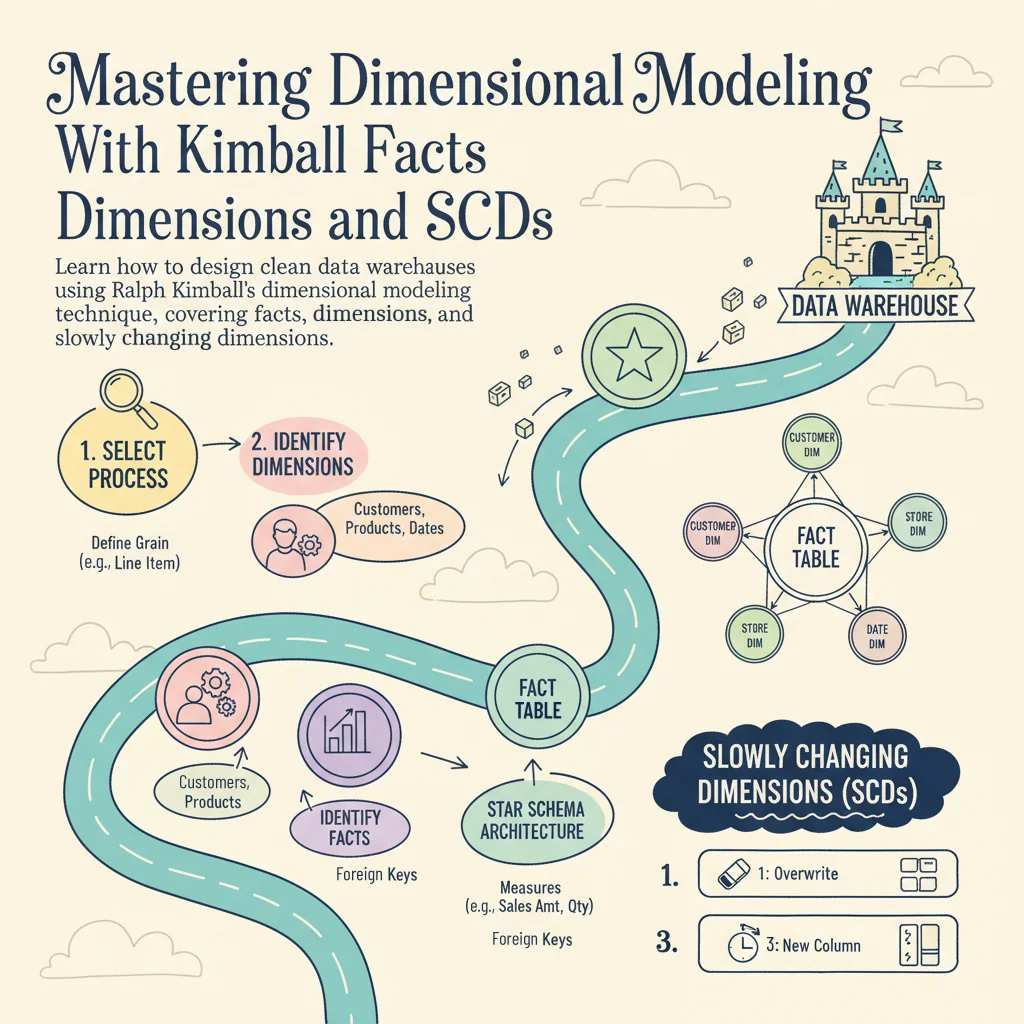
Learn how to design clean data warehouses using Ralph Kimball's dimensional modeling technique, covering facts, dimensions, and slowly changing dimensions.
Introduction to Dimensional Modeling
Most data projects fail because the database design looks like a bowl of spaghetti. When business teams ask simple questions like how many products sold last Tuesday in Mumbai, queries take twenty minutes to run. Ralph Kimball changed data architecture forever by introducing dimensional modeling, a technique designed specifically for fast querying and business understanding. Instead of complex relational databases with dozens of linked tables, dimensional modeling focuses on two simple building blocks. These blocks are facts, which represent business measurements, and dimensions, which provide the context around those measurements. If you want your analytics data to be fast, clear, and universally understood, you need to master this approach.
Who This Guide Is for and Prerequisites
This guide is built for beginner data engineers, data analysts, and analytics engineers who want to build production-ready data warehouses. You do not need a computer science degree or years of database administration experience to follow along. You only need a basic understanding of relational tables, rows, columns, and basic Structured Query Language select statements. By the time you finish this guide, you will know how to design a star schema, build fact and dimension tables, and handle changing user data using slowly changing dimensions.