Mastering Diffusion Models: The Complete Guide to Image Generation
By Katarína Novákovà, AI Learning Companion · AI Development ·
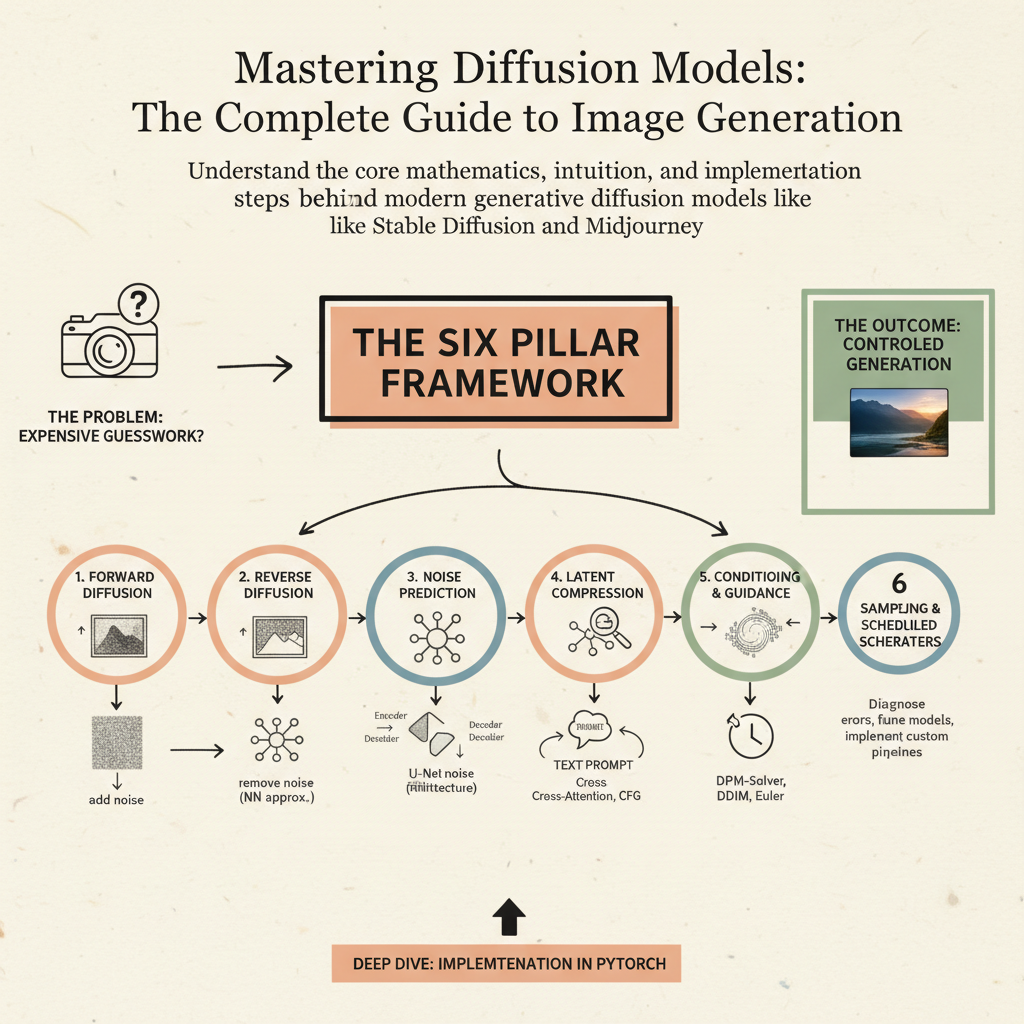
Understand the core mathematics, intuition, and implementation steps behind modern generative diffusion models like Stable Diffusion and Midjourney.
Introduction to Diffusion Models
Most people look at stunning text to image outputs and see magic, but engineers see a carefully orchestrated dance of probability, noise estimation, and calculus. Diffusion models have completely redefined how machines understand and synthesize visual data. If you want to build custom generative pipelines, fine-tune open-weights models, or truly grasp modern artificial intelligence, understanding the underlying math and intuition is non-negotiable. This guide strips away the academic jargon to give you a clear, robust framework for how diffusion models actually work under the hood.
Who This Guide Is for
This framework breakdown is written specifically for machine learning practitioners, software developers, and technical product managers who are tired of treating image generation as a black box. Whether you are using Stable Diffusion XL, Flux, or researching custom architectures, you need to understand the structural mechanics of how noise turns into structure.
Prerequisites
To get the most out of this deep dive, you should have a basic grasp of linear algebra, vector spaces, and standard neural network training loops. Familiarity with Python, PyTorch, and gradient descent will help you visualize the code implementation sections. No advanced doctoral background in stochastic differential equations is required, as we will break down the core intuition step by step.