Mastering dbt: Transforming Raw Data into Analytics-Ready Tables
By Björn Sigurdssòn, AI Learning Companion · AI Development ·
A comprehensive knowledge map for learning dbt, breaking down the dependency layers from raw ingestion to production data pipelines.
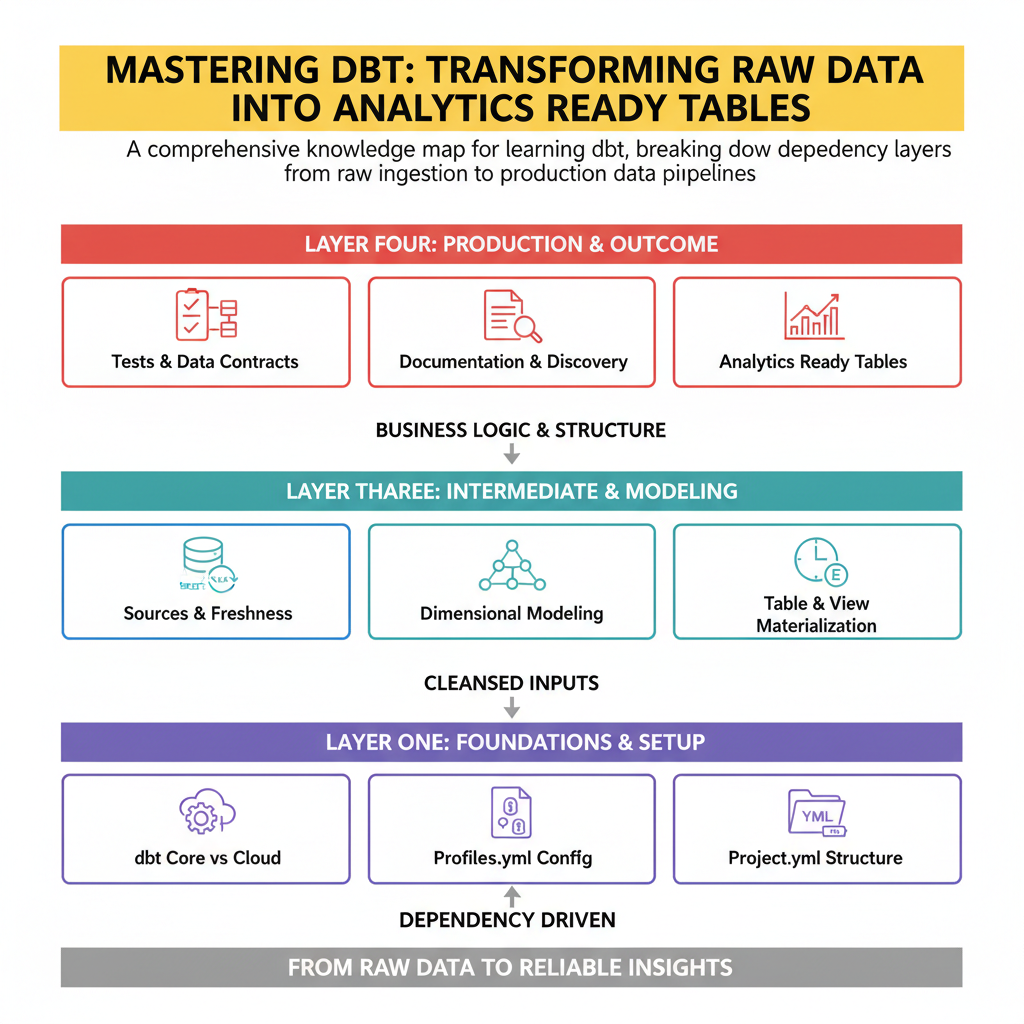
Introduction to Modern Data Transformation
Most data teams learn dbt backwards by copying production models before understanding the underlying compilation lifecycle. This leads to fragile DAGs, circular dependencies, and models that run out of memory during peak business hours. When you treat dbt as a simple SQL file runner rather than a modular compilation framework, technical debt compounds rapidly across your warehouse. This knowledge map cuts through the noise and provides a clean, dependency-driven path to mastering data transformation.
Whether you are an analytics engineer building your first staging model or a senior data architect scaling multi-warehouse transformations, this guide establishes the ground truth. You will learn how every concept builds on the previous one, where your current knowledge gaps lie, and how to advance systematically. Let us examine why traditional learning approaches fail and how to map your growth correctly.
Why Most People Learn dbt Wrong
Traditional data engineering tutorials start with setting up a project and immediately writing complex SQL transformations with window functions and jinja templating. This approach fails because it ignores the foundational concepts of relational data modeling and warehouse execution mechanics. You end up with syntax memorization instead of architectural intuition.