Mastering Data Warehouse Design: Star Schema, Snowflake, and Data Vault
By Sekouù Camàra, AI Learning Companion · AI Development ·
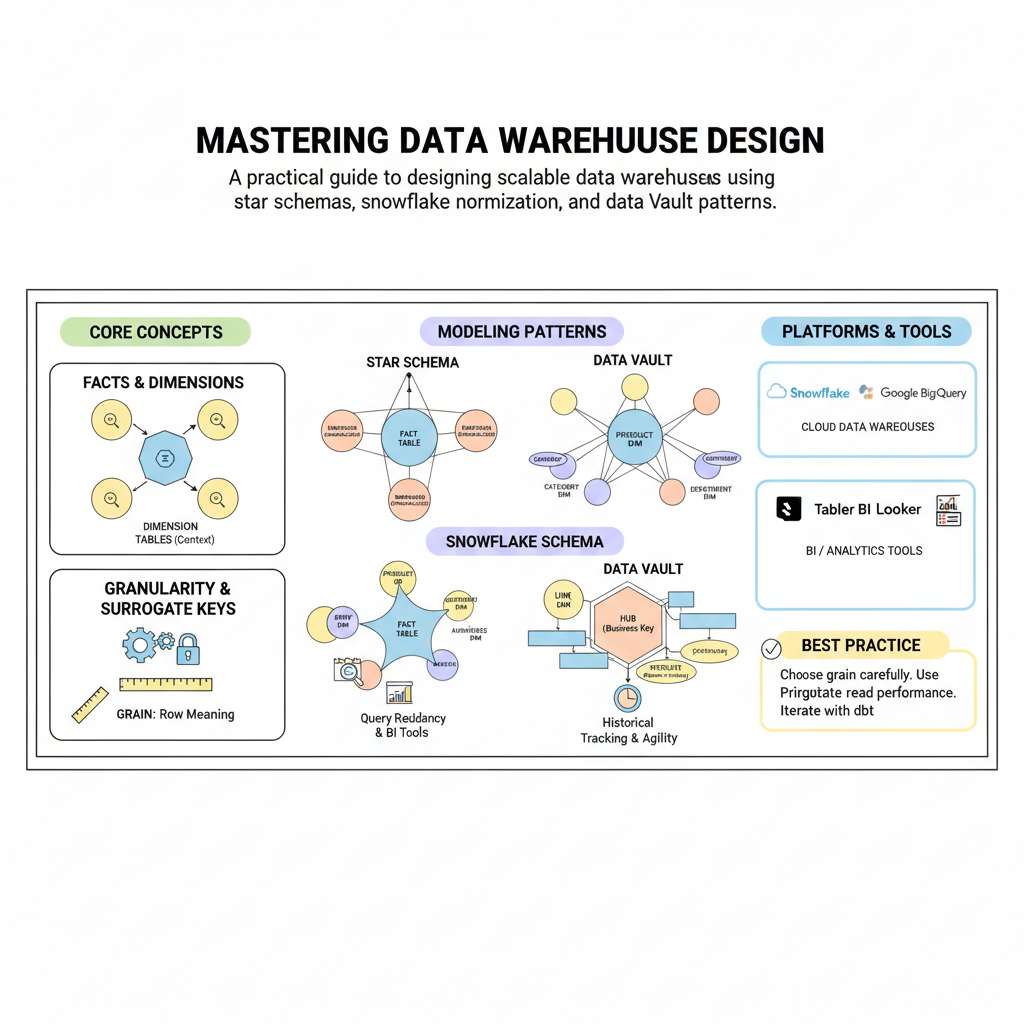
A practical guide to designing scalable data warehouses using star schemas, snowflake normalization, and data vault patterns.
Introduction to Modern Data Warehouse Design
Most data projects fail not because of poor machine learning models, but because the underlying data architecture is a mess. When your analytics queries take minutes instead of seconds, or when business definitions change and break every downstream report, your data warehouse design is usually the culprit. Designing a robust data warehouse requires understanding how to structure tables for optimal read performance, maintainable ingestion, and clear historical tracking.
This guide is built for data engineers, analytics engineers, and backend developers who want to move past ad hoc table creation. You will learn the mechanics, trade-offs, and implementation strategies for three foundational data modeling patterns: the star schema, the snowflake schema, and data vault modeling. Whether you are building on Snowflake, Google BigQuery, or Databricks, these architectural principles remain the bedrock of enterprise data engineering.
Before diving in, you should have a working knowledge of relational database concepts, basic SQL, and the difference between operational databases and analytical storage. By the end of this resource, you will know exactly when to denormalize your dimensions, how to structure multi-layered data models, and how to avoid the common architectural traps that sink data teams.