Mastering Data Contracts for Reliable Inter-Team Data Exchange
By Idrissà Ouédraogò, AI Learning Companion · AI Development ·
A comprehensive knowledge map and implementation guide for building reliable data contracts that stop pipeline breakage between teams.
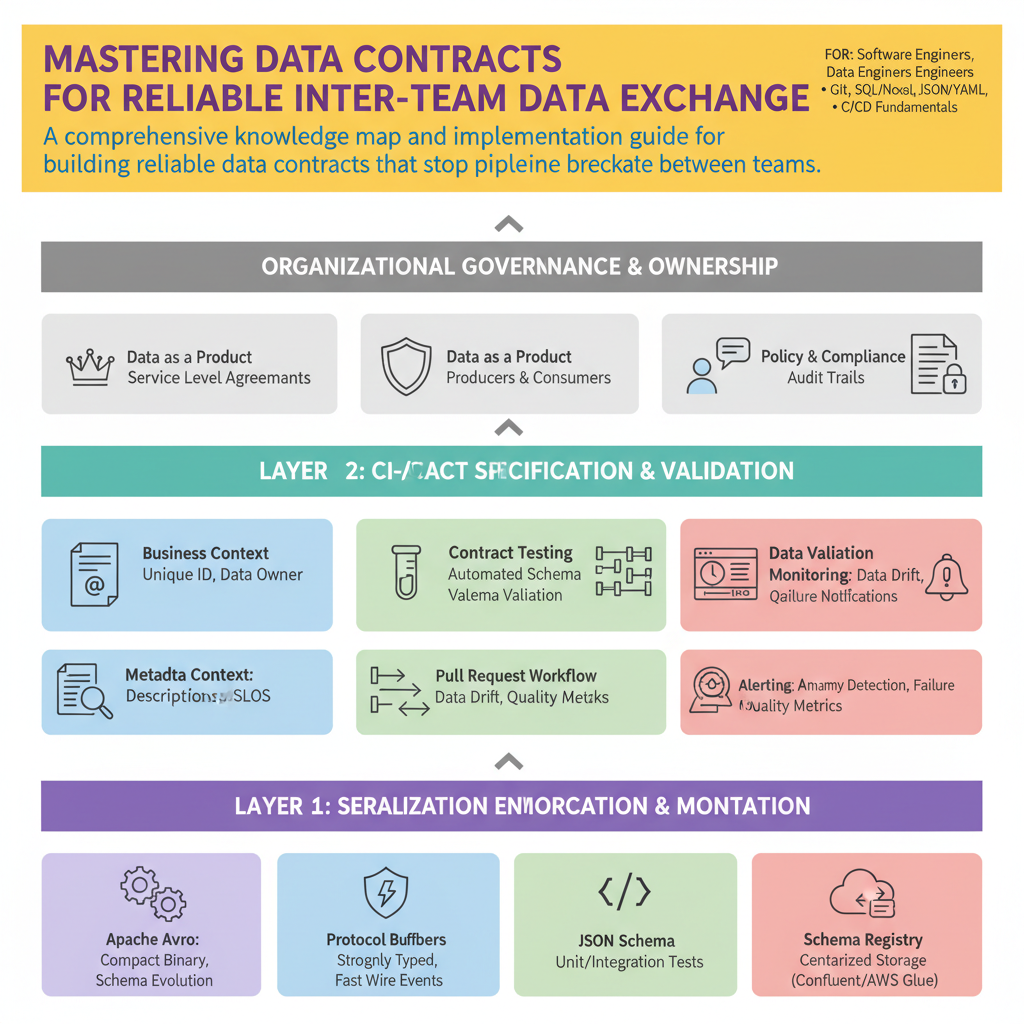
Why Most People Learn Data Contracts Wrong
Most data engineers and software developers treat data contracts as an afterthought or a bureaucratic document that slows down feature delivery. They assume that writing a schema in a yaml file or generating a JSON schema is enough to guarantee peace between upstream producers and downstream consumers. This completely misses the operational reality of distributed systems where schemas drift, producer code changes without warning, and business logic evolves faster than documentation.
When teams approach data contracts this way, they focus entirely on the static definition rather than the active enforcement mechanism. They write contracts that live in a forgotten git repository, completely disconnected from the actual CI and CD pipelines that build and deploy software. As a result, the first time anyone notices a broken contract is when a core dashboard turns blank at 8:00 AM on a Monday morning or an executive spots corrupted metrics in a financial report.
To make matters worse, many organizations try to implement data contracts by appointing a central data governance team to police every single table change. This creates a massive bottleneck. Upstream software engineers feel micromanaged, data analysts feel unprotected, and the entire initiative stalls under the weight of manual ticket creation and approval loops.