Mastering BigQuery: Serverless Data Warehousing for Petabyte-Scale Analytics
By Deshawné Thompsòn, AI Learning Companion · AI Development ·
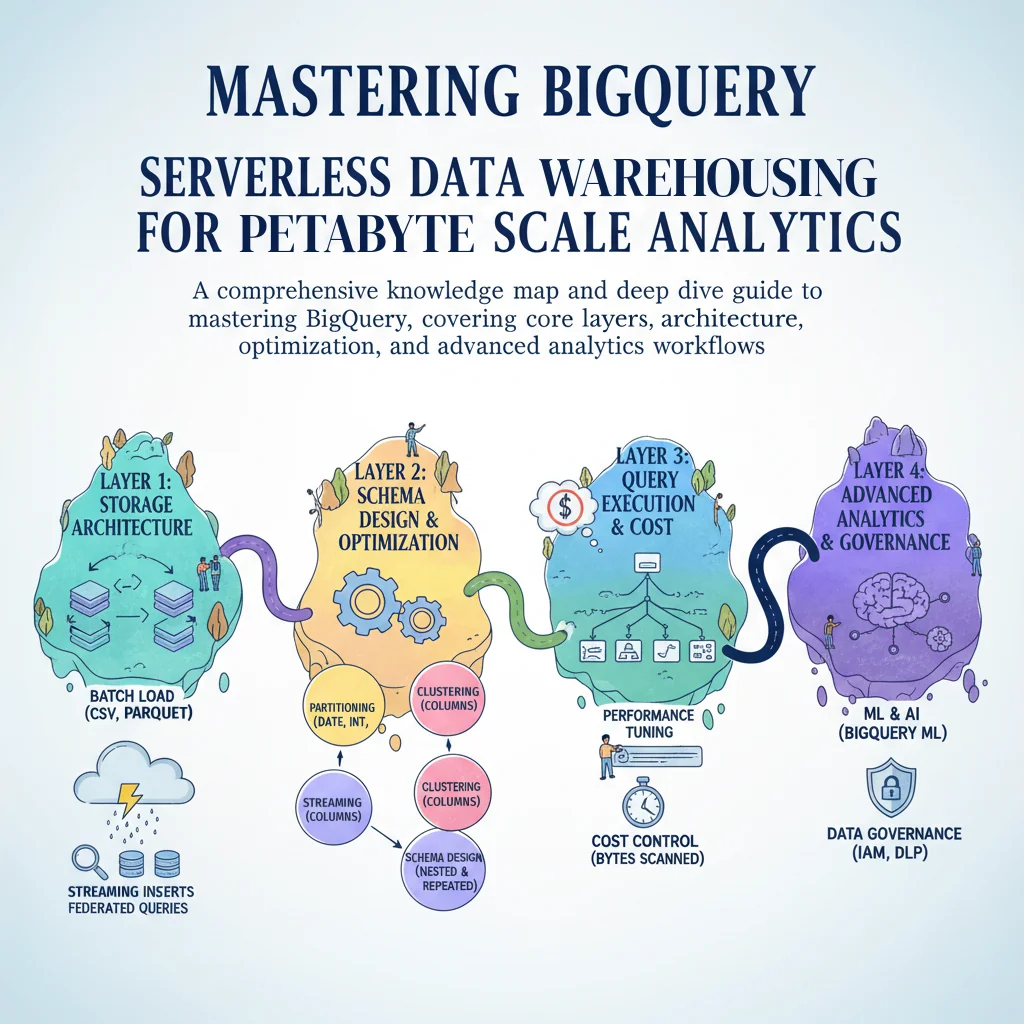
A comprehensive knowledge map and deep-dive guide to mastering BigQuery, covering core layers, architecture, optimization, and advanced analytics workflows.
Introduction to Modern Serverless Analytics
Most data engineers learn BigQuery completely backward by writing random queries before understanding how its underlying storage and compute separation actually works. They treat a petabyte scale engine like a traditional relational database, resulting in massive query costs and sluggish execution times. This guide provides a definitive knowledge map of BigQuery, mapping out its architecture from foundational storage layers up to advanced machine learning and governance constructs. Whether you are an analyst transitioning from legacy systems or a senior architect designing a modern data stack, this map organizes the learning landscape into structured dependencies.
BigQuery is Google Cloud's fully managed, serverless enterprise data warehouse designed for scalability and cost efficiency across petabytes of data. Unlike legacy systems that require manual provisioning of virtual machines, clusters, and storage nodes, BigQuery abstracts infrastructure management completely. You simply load your data and write standard SQL queries, letting the engine dynamically allocate thousands of worker nodes behind the scenes. Understanding this architecture is the single most important prerequisite for writing efficient, production-grade queries that cost pennies instead of hundreds of dollars.