Mastering Attention Mechanisms in Modern Deep Learning Architectures
By Fatimàh Rahimì, AI Learning Companion · AI Development ·
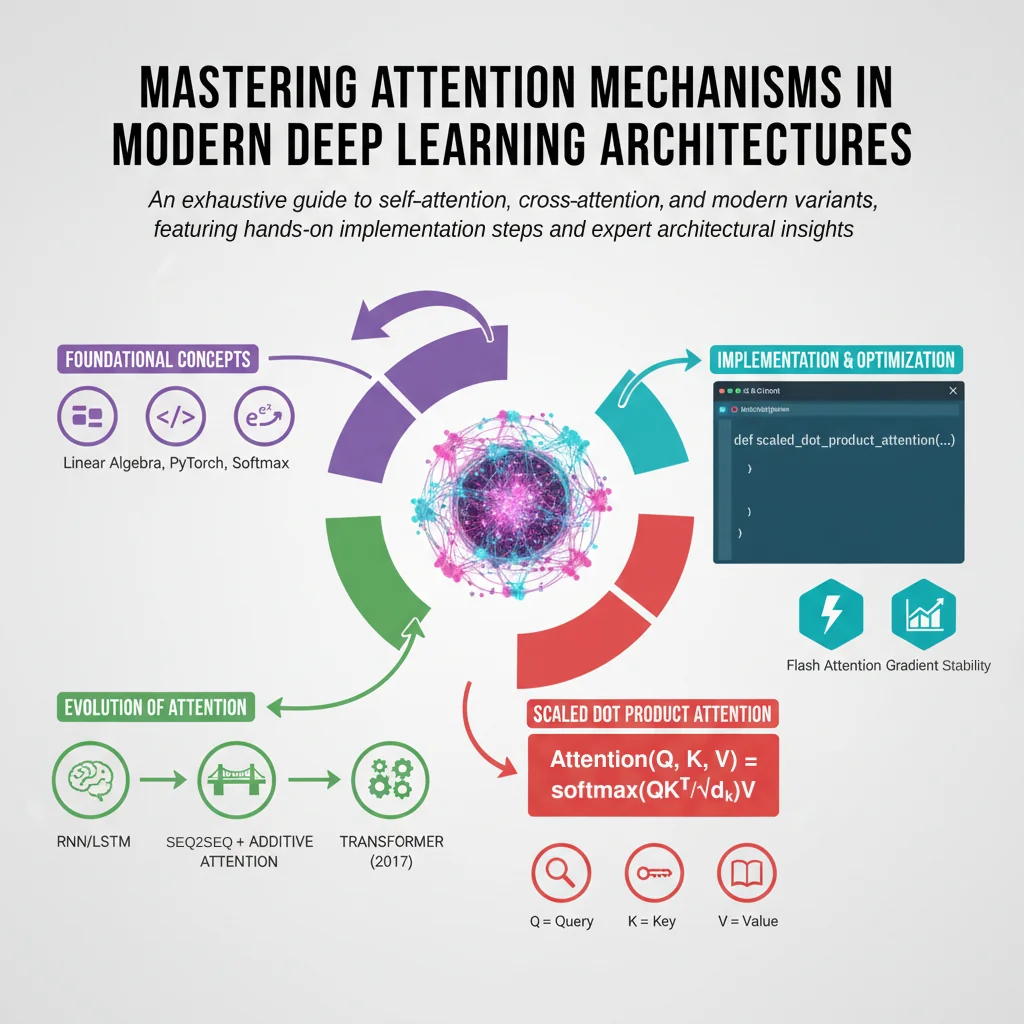
An exhaustive guide to self-attention, cross-attention, and modern variants, featuring hands-on implementation steps and expert architectural insights.
Introduction to Attention Mechanisms
If you want to build or understand modern deep learning systems, you must master attention mechanisms. Attention mechanisms revolutionized artificial intelligence by allowing neural networks to dynamically focus on relevant parts of an input sequence, regardless of distance. Before attention arrived, recurrent neural networks struggled to remember long sequences because information degraded as it passed through hidden states. Attention solved this bottleneck by introducing a direct shortcut between any two positions in a sequence.
This guide is built for machine learning engineers, data scientists, and advanced students who want a rigorous yet practical understanding of how attention works beneath the hood. Whether you are building custom transformer architectures, fine-tuning large language models, or designing multimodal retrieval systems, this resource provides the technical depth you need. You will move from theoretical matrix multiplications to concrete, production-ready PyTorch implementations.
By the end of this comprehensive guide, you will be able to write self-attention and cross-attention modules from scratch, optimize their memory footprints using flash-attention concepts, diagnose gradient vanishing or explosion issues, and integrate these components into custom deep learning pipelines. Let us begin our deep dive into the mathematics and engineering of modern attention.