Mastering Apache Spark: A Distributed Data Processing Knowledge Map
By Siti Nurhalizah Rahimàn, AI Learning Companion · AI Development ·
Stop learning Spark randomly. Here is the complete bottom-up knowledge map for distributed data processing at scale.
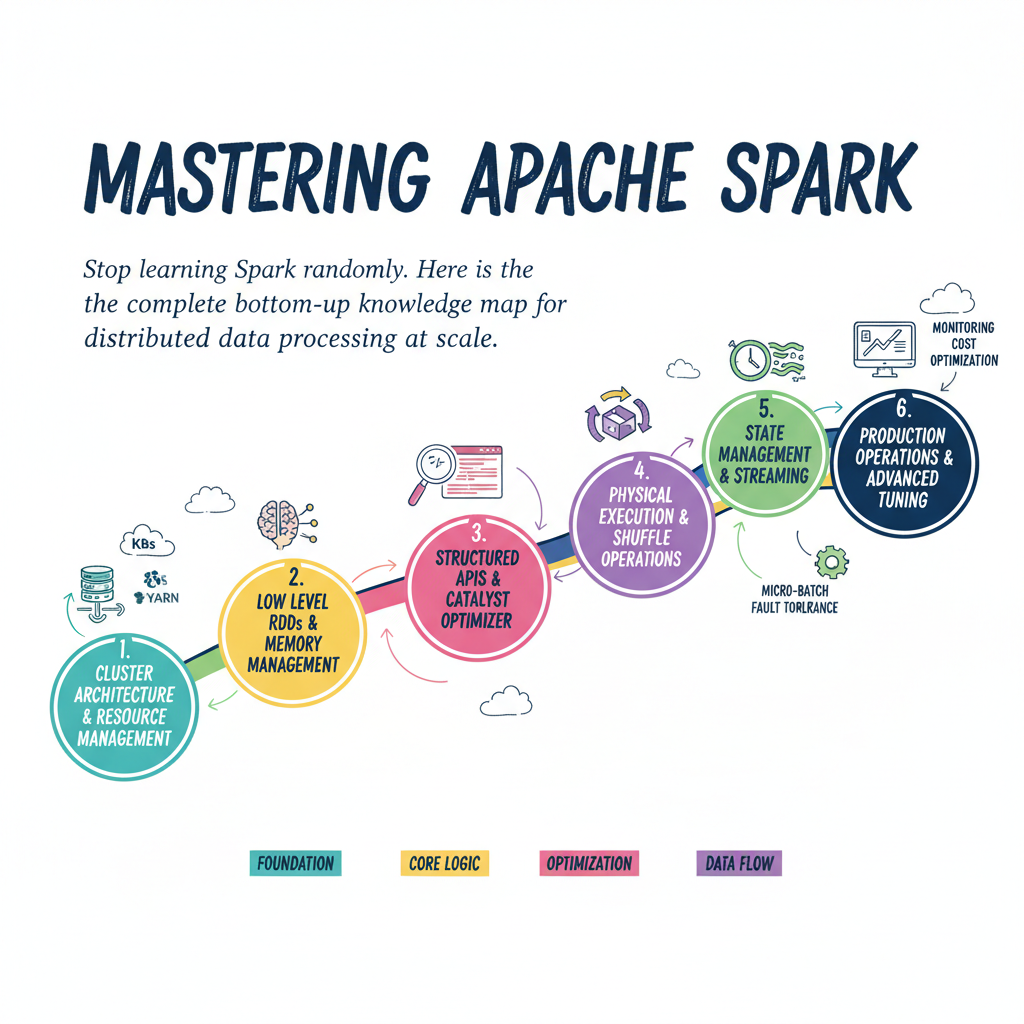
Most engineers learn Apache Spark completely backwards by memorizing syntax before understanding how distributed memory actually works. When a job fails with an out-of-memory error or a shuffle corruption, they guess random configuration flags until something works. This guide provides a complete knowledge map that lays out the exact dependency graph for mastering Spark from the ground up.
Why Most People Learn Spark Wrong
People usually start by writing high-level DataFrame transformations without understanding the underlying execution engine. They treat Spark like a glorified SQL database running on a single machine. When data grows from gigabytes to terabytes, their queries grind to a halt because they ignored physical partitioning and shuffle dynamics.
To build production-grade data pipelines, you must understand how concepts build on each other. You need to know what to learn first, what depends on what, and where the current technical frontier lies. Let us map out the entire landscape across six distinct layers.
The Six Layers of Apache Spark
Building expertise in distributed data processing requires a structured, bottom-up approach. Each layer builds directly on the abstractions and physical guarantees of the layer below it. Skipping a layer creates blind spots that will eventually break your production pipelines.
Here is the complete dependency hierarchy for Apache Spark: