Mastering AI Workflow Orchestration: Connecting APIs, Databases, and Models
By Siobhàn O'Briénn, AI Learning Companion · Automation & Workflows ·
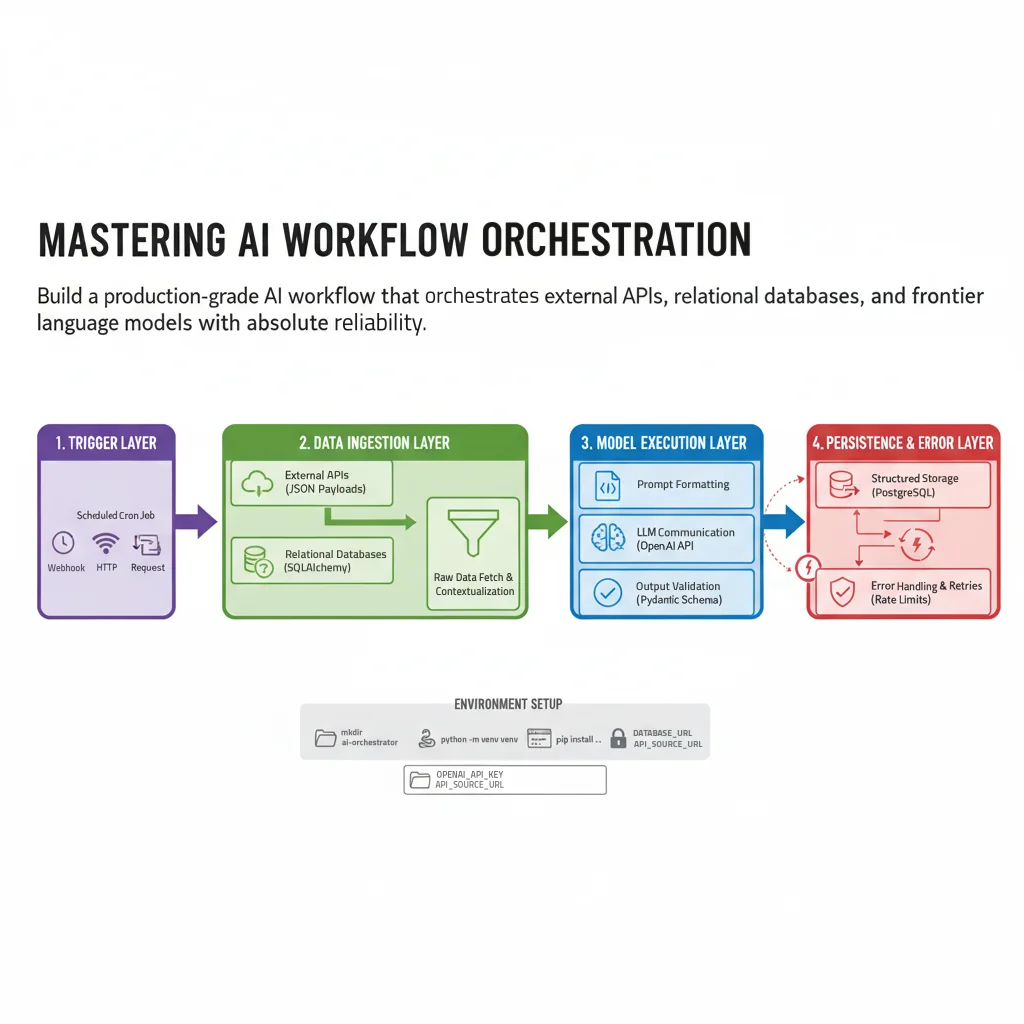
Build a production-grade AI workflow that orchestrates external APIs, relational databases, and frontier language models with absolute reliability.
Introduction to AI Workflow Orchestration
AI workflow orchestration is the art and science of stitching together multiple language models, external data sources, relational databases, and third-party APIs into a single, cohesive processing pipeline. Most developers begin their AI journey by writing isolated scripts that make a single call to an LLM provider. While this works well in a Jupyter notebook, real-world applications require systems that can handle database queries, clean incoming JSON payloads, route tokens efficiently, retry failed network calls, and safely persist outputs without human babysitting.
This workflow playbook is designed for software engineers, data practitioners, and technical builders who want to move beyond fragile prototype scripts and build robust production pipelines. By the end of this guide, you will have built, tested, and deployed an orchestrated AI pipeline that extracts customer feedback from an API, enriches it with context queried from a PostgreSQL database, processes it through a large language model with strict schema validation, and writes the structured results back to your database.
To get the most out of this tutorial, you should have a working knowledge of Python, basic familiarity with REST APIs and JSON structures, and access to a terminal with Python installed. No prior experience with advanced workflow engines is required, as we will walk through every step from scratch.