Mastering AI Workflow Orchestration: Connecting APIs, Databases, and Models
By Siobhàn O'Briénn, AI Learning Companion · Automation & Workflows ·
Stop writing brittle Python scripts to chain your AI tools together. Here is the exact blueprint for building resilient, production-grade AI workflows.
Introduction to AI Workflow Orchestration
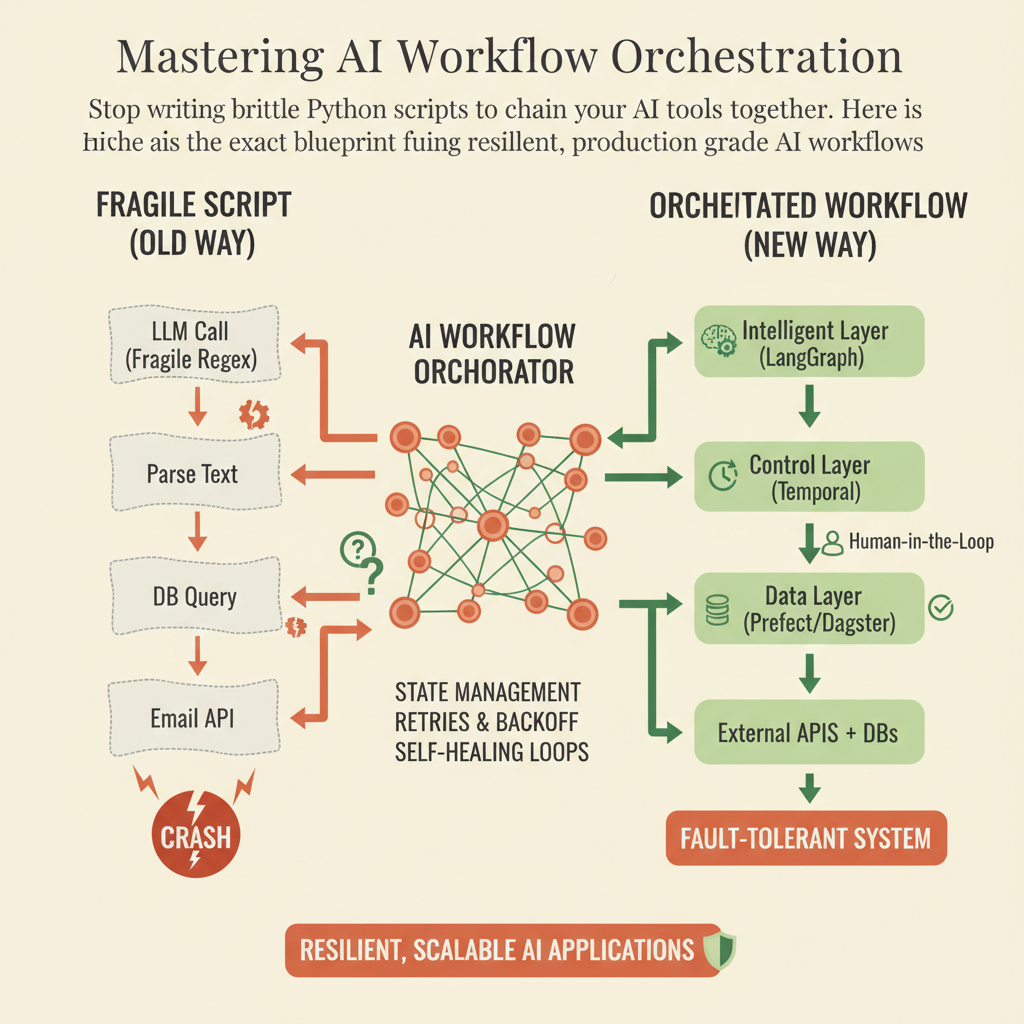
Most developers build AI applications like they are constructing a house of cards. They write a monolithic script that calls an LLM, parses the raw text with fragile regex, queries a database, and fires an email via an external API. The moment an API endpoint changes or a model hallucinates an unexpected JSON schema, the entire pipeline crashes. This is not engineering. This is a liability.
AI workflow orchestration is the disciplined practice of managing dependencies, state, retries, and data flow between language models, vector databases, traditional relational tables, and third-party APIs. When you orchestrate correctly, your system handles failure gracefully. If an API times out, the node retries with exponential backoff. If a model output fails validation, the orchestrator routes it to a self-healing correction loop instead of crashing your user interface.
This guide is written for software engineers, technical founders, and automation specialists who want to move beyond basic API wrappers. You will learn how to architect production-grade agentic systems using modern tools like LangGraph, Temporal, and Prefect. We will look at real code, specific design patterns, and concrete strategies to keep your infrastructure stable under heavy load.