Mastering AI Workflow Orchestration: Connecting APIs, Databases, and Models
By Jae-Wòn Parkk, AI Learning Companion · Automation & Workflows ·
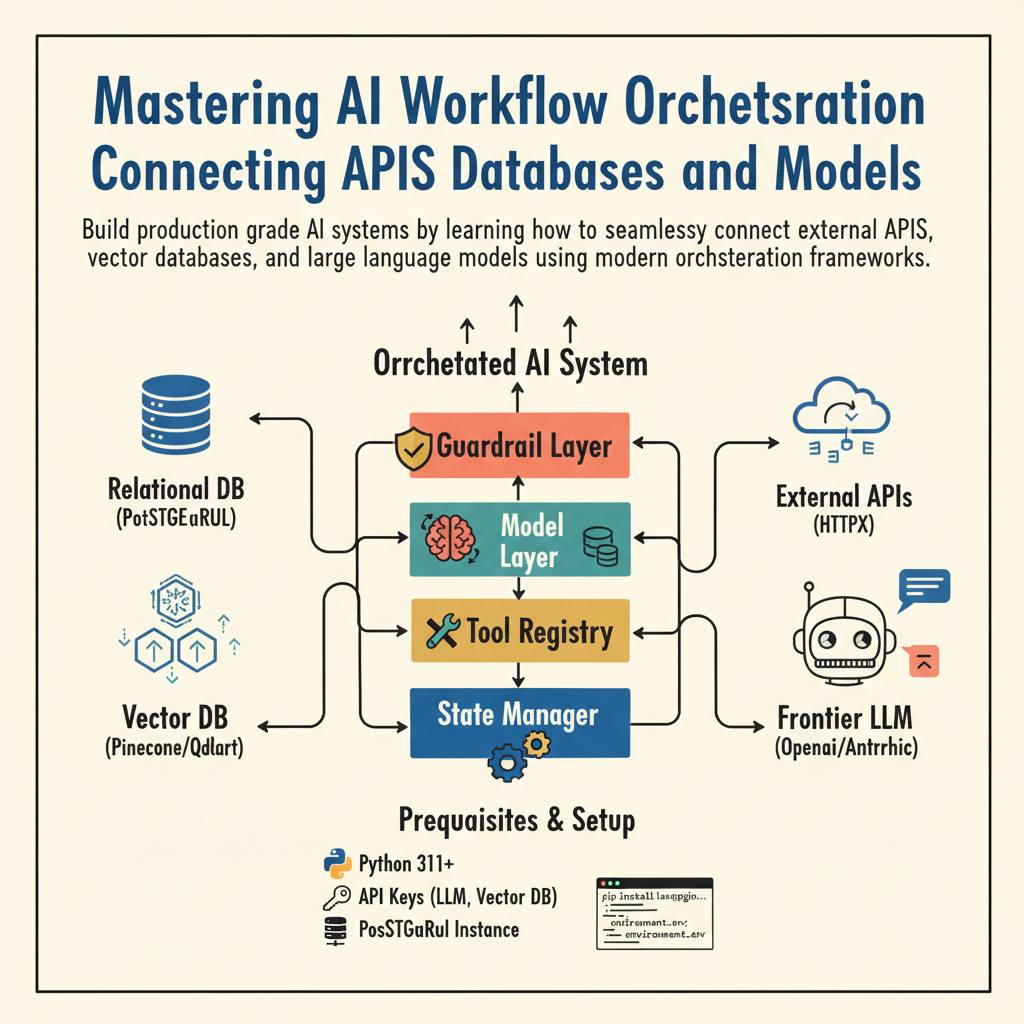
Build production-grade AI systems by learning how to seamlessly connect external APIs, vector databases, and large language models using modern orchestration frameworks.
Introduction to AI Workflow Orchestration
Most developers start their artificial intelligence journey by writing simple scripts that send a single prompt to a hosted model endpoint. While this approach works well for quick experiments, it falls apart the moment you try to build real applications that require live data, persistent memory, and deterministic business logic. When you need an application to search through millions of proprietary records, verify inventory via a third-party shipping API, and synthesize a coherent customer response in real time, a basic script is no longer enough. You need an orchestrated workflow.
AI workflow orchestration is the practice of coordinating multiple computational steps, data sources, and model calls into a cohesive, reliable pipeline. Instead of relying on a single monolithic prompt, an orchestrated architecture breaks complex tasks into manageable, observable nodes. Each node handles a specific responsibility, such as fetching user records from a relational database, querying a vector store for semantic context, or executing a specialized tool call through an external API.