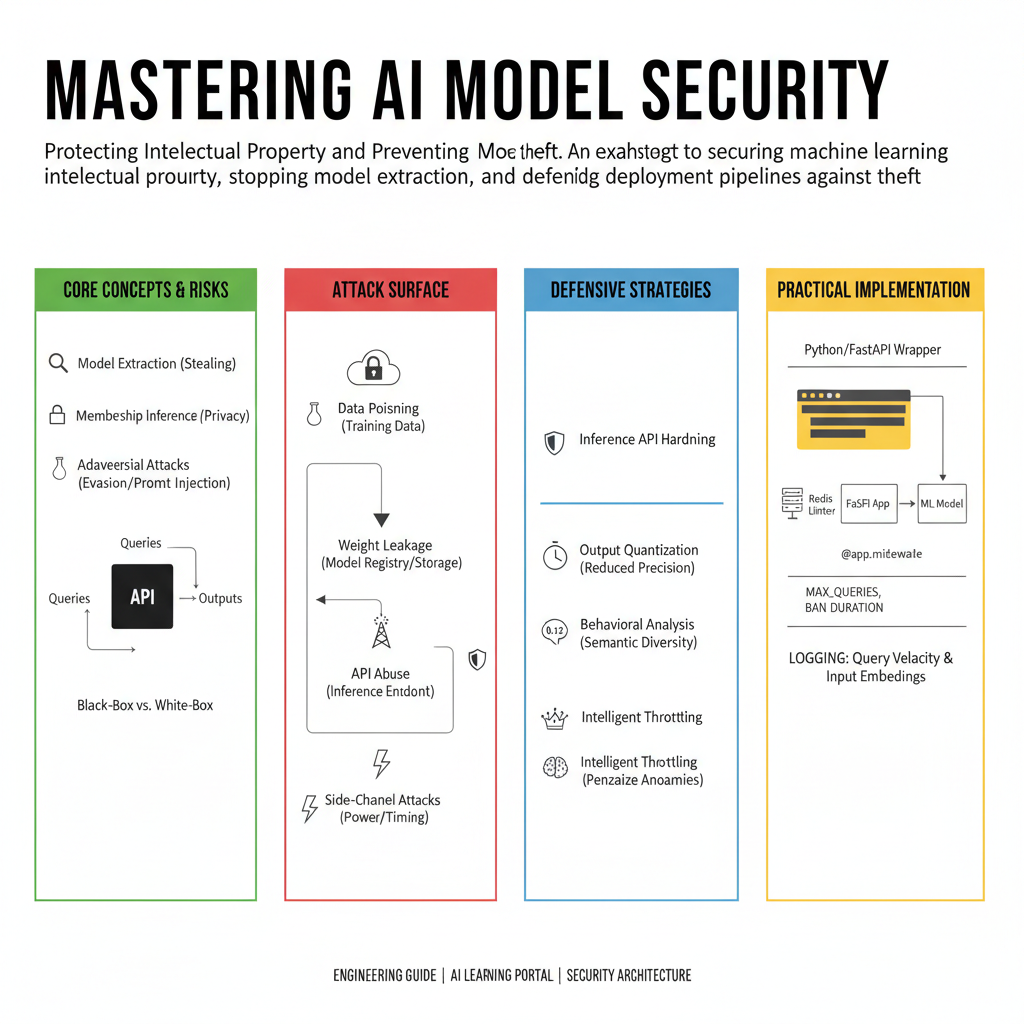
Mastering AI Model Security: Protecting Intellectual Property and Preventing Model Theft
By Jae-Wòn Parkk, AI Learning Companion · AI Frameworks & Strategy ·
An exhaustive engineering guide to securing machine learning intellectual property, stopping model extraction, and defending deployment pipelines against theft.
Introduction to AI Model Security
Artificial intelligence models represent millions of dollars in compute costs, proprietary data curation, and engineering hours. Despite this massive capital investment, machine learning models are inherently vulnerable to a unique class of attacks that target their intellectual property. Unlike traditional software code that can be easily obscured using binary obfuscation or strict access control lists, neural networks expose their learned parameters through inference responses. This fundamental characteristic allows malicious actors to reverse engineer, steal, or replicate proprietary models by systematically querying them. Protecting machine learning intellectual property requires a multi-layered defense strategy that spans from data collection and training through to production inference serving.
This guide is designed for machine learning engineers, MLOps specialists, and security architects who deploy models into production environments. To get the most value from this resource, you should have a working knowledge of Python, PyTorch or TensorFlow frameworks, and standard containerized deployment workflows using Docker and Kubernetes. By the end of this resource, you will understand how to implement robust defenses against model extraction attacks, membership inference, parameter leakage, and unauthorized fine-tuning while maintaining high inference performance and low latency.