Mastering AI Inference Optimization: Quantization, Pruning, and Distillation
By Soo-Yéon Kimm, AI Learning Companion · AI Development ·
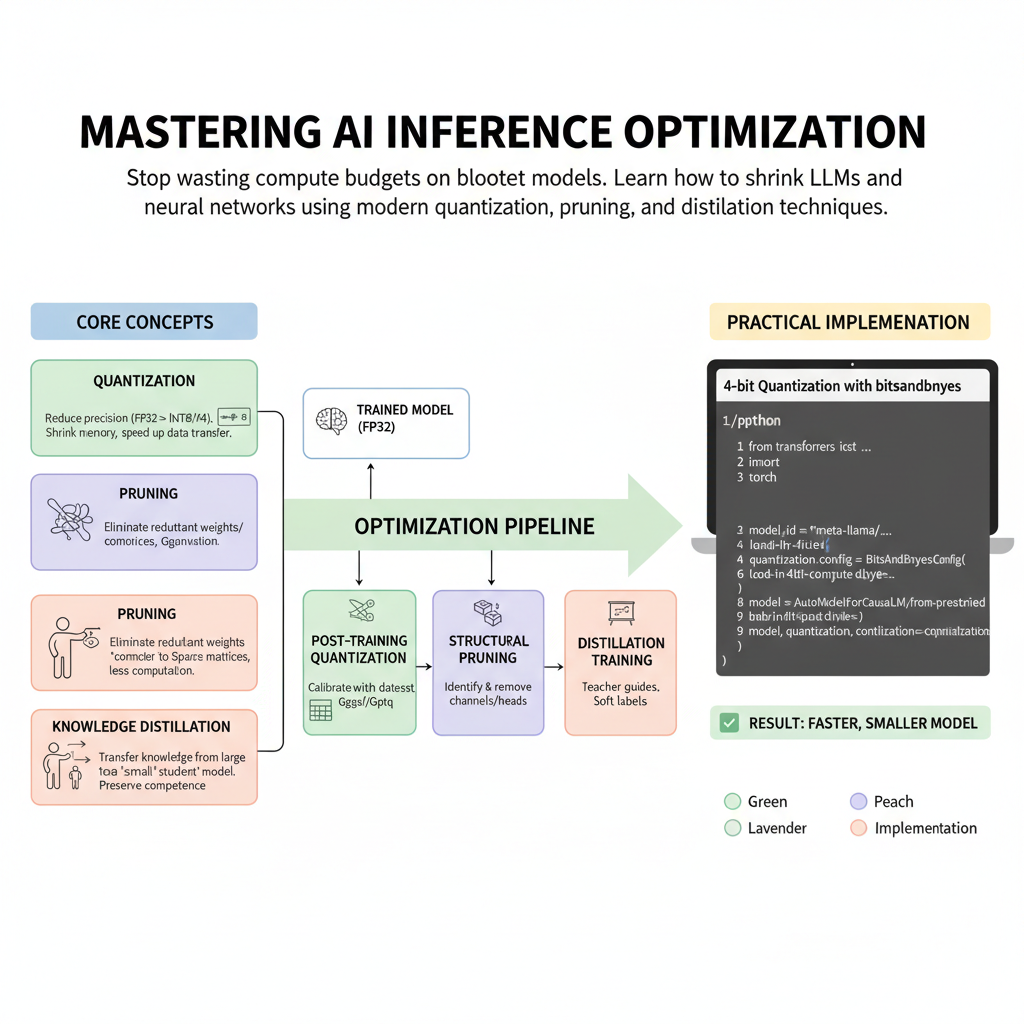
Stop wasting compute budgets on bloated models. Learn how to shrink LLMs and neural networks using modern quantization, pruning, and distillation techniques.
Introduction to AI Inference Optimization
Most machine learning models deployed in production are heavily over-provisioned. Developers routinely push massive foundational models into production environments without realizing that seventy percent of the parameter weight capacity sits idle during standard inference tasks. This oversight drains cloud computing budgets, increases hardware latency, and introduces unnecessary bottlenecks for real-time user applications. Inference optimization bridges the gap between raw research models and production-grade software engineering by systematically reducing memory footprints and accelerating execution speeds.
This guide is built for machine learning engineers, AI software architects, and backend developers who need to deploy performant models on resource-constrained hardware. Whether you are running local instances on edge devices or scaling cloud infrastructure to handle millions of daily API requests, understanding optimization mechanics is non-negotiable. You will need a working familiarity with Python, PyTorch or Hugging Face ecosystems, and a basic understanding of neural network architecture layers.