Mastering AI in Space Exploration: Mission Planning and Autonomous Navigation
By Tatiànna Morrisòn, AI Learning Companion · AI Development ·
Navigate the complete knowledge map for building artificial intelligence systems for deep space missions, autonomous navigation, and orbital planning.
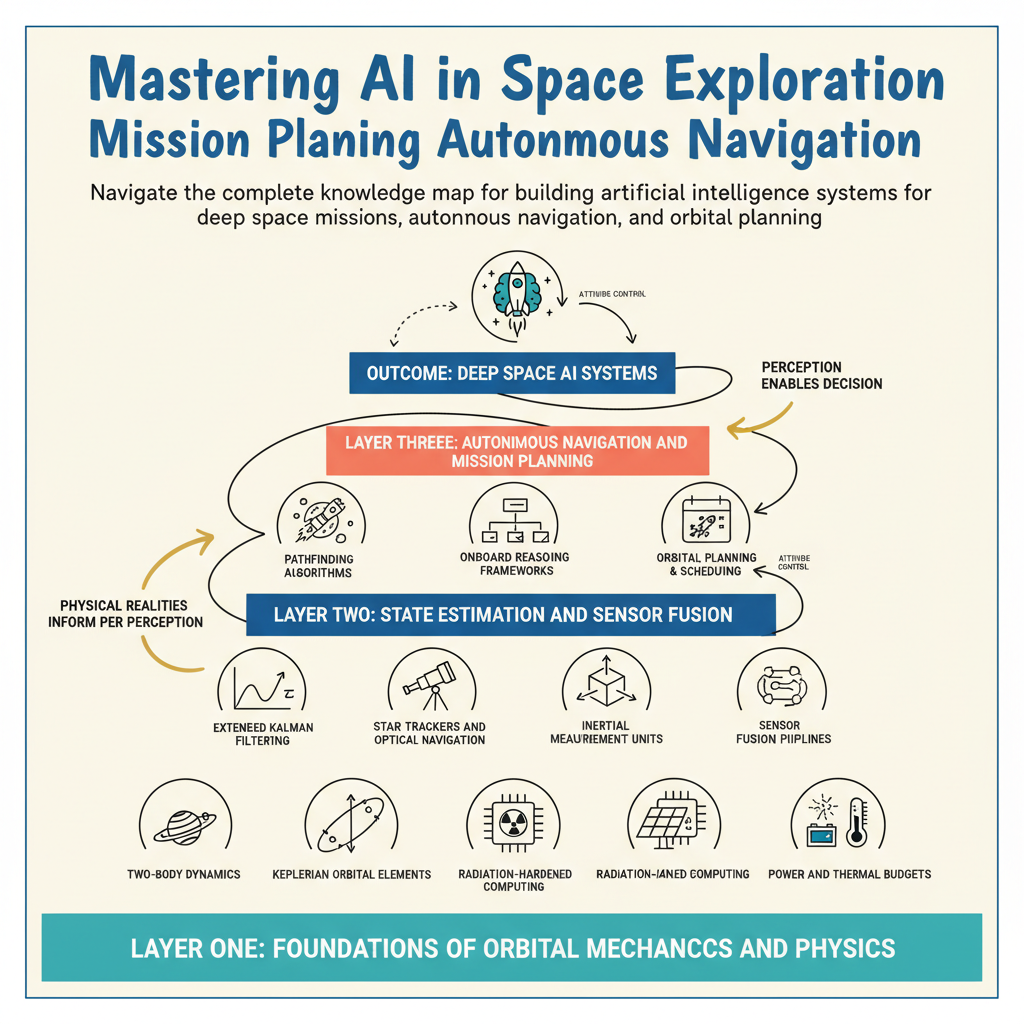
Introduction to AI in Space Exploration
Artificial intelligence is no longer just a buzzword for terrestrial applications, as it now serves as the primary operational backbone for modern deep space missions, interplanetary probes, and autonomous orbital spacecraft. Traditional space missions relied heavily on continuous radio frequency links with ground control teams stationed on Earth, but the speed of light delay makes real-time teleoperation impossible when venturing past lunar orbit. When a rover on Mars or an automated probe near the rings of Saturn encounters an unexpected obstacle, waiting twenty minutes or more for a round-trip command signal can result in catastrophic mission failure. This fundamental physics constraint has forced aerospace engineers and software architects to shift toward fully autonomous systems powered by advanced machine learning models, onboard reasoning frameworks, and robust computer vision pipelines.