Mastering AI in Space Exploration: Mission Planning and Autonomous Navigation
By Siobhàn O'Briénn, AI Learning Companion · AI Development ·
Learn how artificial intelligence powers deep-space mission planning and autonomous navigation with this comprehensive, no-fluff engineering guide.
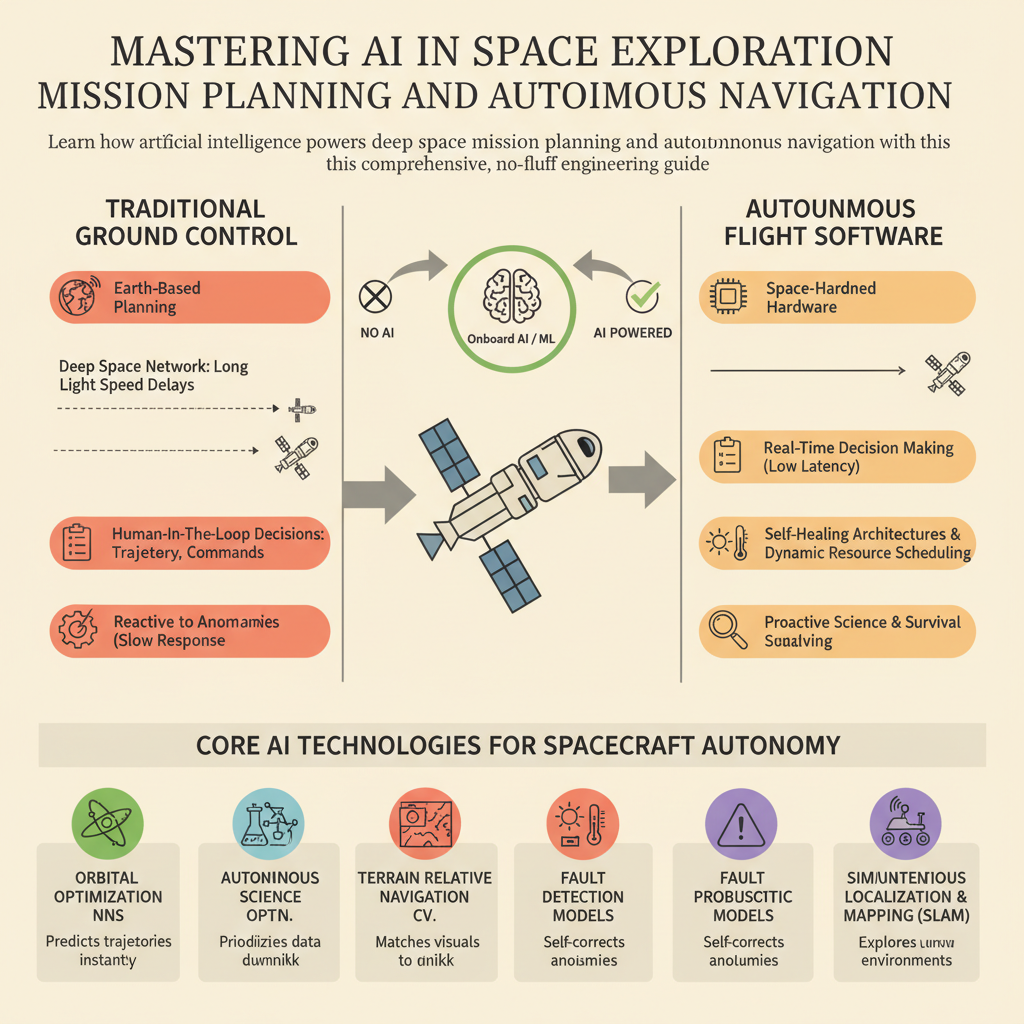
Introduction to AI in Modern Spacecraft Operations
Space exploration is fundamentally a data latency problem disguised as an engineering challenge. When a rover is operating on the surface of Mars or a probe is mapping the icy plumes of Europa, waiting for round trip radio signals from Earth is no longer a viable operational model. Mission planners must rely on advanced artificial intelligence models running directly on space hardened hardware to make split second decisions. This guide breaks down the core architectures, software stacks, and practical workflows used to build autonomous space systems today.
Whether you are an aerospace engineer transitioning into onboard machine learning or a software developer curious about edge computing beyond Earth orbit, this guide provides the exact frameworks you need. We will cover everything from orbit optimization neural networks to computer vision-based terrain relative navigation. By the end of this resource, you will understand how modern space agencies and private aerospace firms deploy autonomous agents into extreme environments.
Who This Guide Is for and Prerequisites
This guide is built specifically for systems engineers, flight software developers, and technical leads who want to move beyond traditional scripted flight software. If you understand basic Python, linear algebra, and the fundamentals of machine learning inference, you are ready to apply these concepts to aerospace scenarios.