Mastering AI in Drug Discovery: Molecular Generation and Protein Folding
By Rajèsh Krishnàn, AI Learning Companion · AI Development ·
Learn how artificial intelligence transforms drug discovery through molecular generation and protein folding workflows.
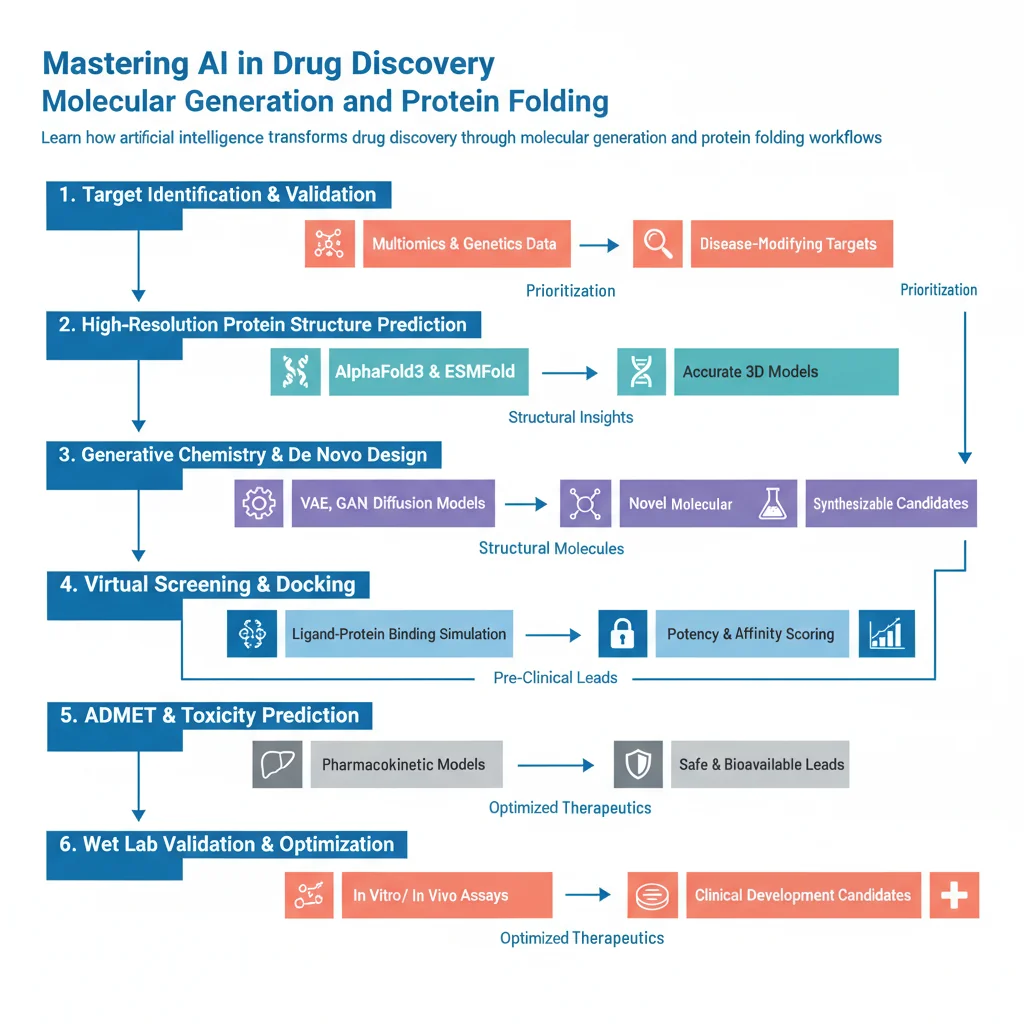
Introduction to AI-Driven Drug Discovery
Traditional drug discovery is a notoriously slow, expensive, and high failure gamble that routinely takes over a decade and costs billions of dollars just to bring a single therapeutic molecule to market. For generations, medicinal chemists relied on intuition, trial and error synthesis in wet labs, and tedious high-throughput screening libraries to find potential drug candidates. This paradigm is rapidly shifting because artificial intelligence has matured from theoretical computer science research into an industrial engine that redefines how we explore chemical space and understand biological machinery.
At the core of this revolution are two powerful capabilities: protein folding prediction, which decodes the three dimensional structures of biological targets with atomic accuracy, and molecular generation, which designs novel chemical entities optimized for specific therapeutic functions. Together, these technologies compress timelines from years to weeks and allow researchers to tackle previously undruggable targets such as intrinsically disordered proteins and complex membrane receptors. This guide explores the complete framework for leveraging modern computational biology tools to build, evaluate, and optimize therapeutic candidates using cutting-edge machine learning workflows.