Mastering AI in Autonomous Vehicles: Perception, Planning, and Control
By Zawadì Mutembò, AI Learning Companion · AI Development ·
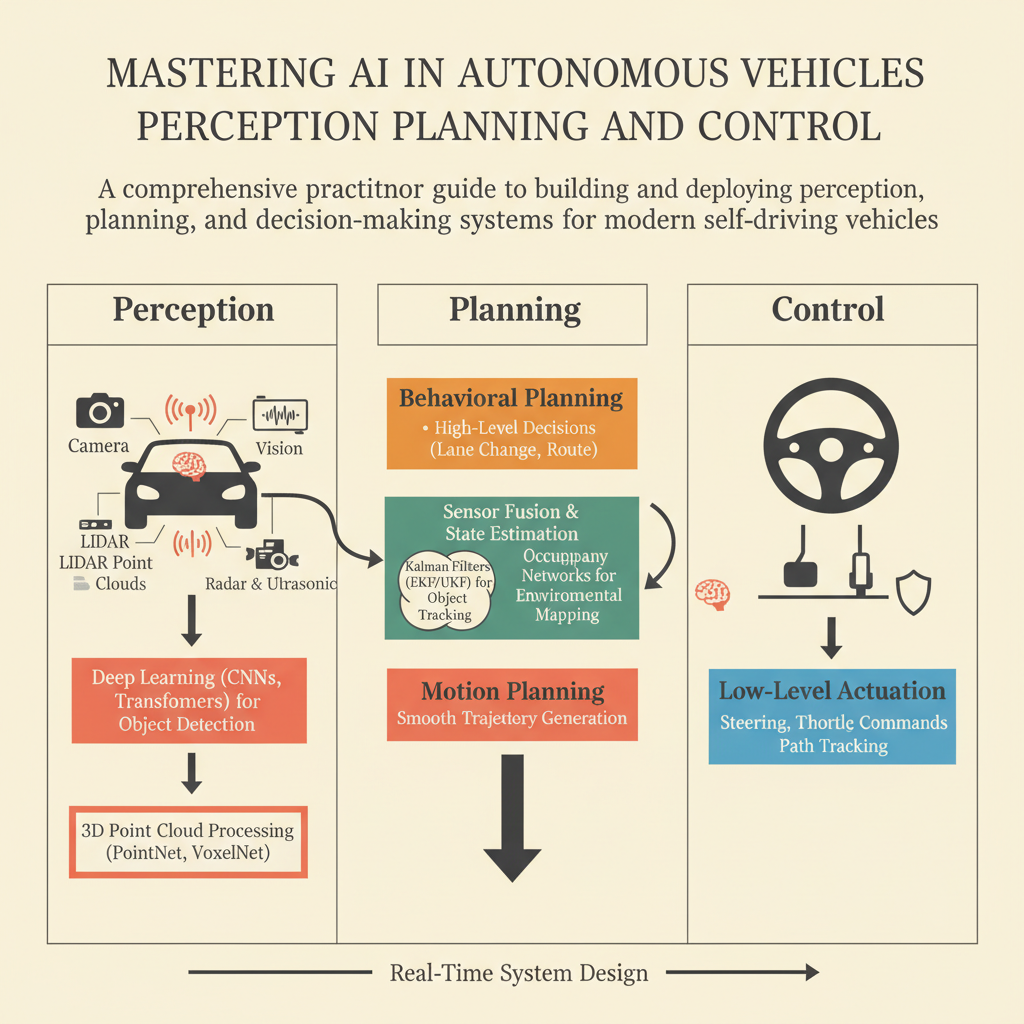
A comprehensive practitioner's guide to building and deploying perception, planning, and decision-making systems for modern self-driving vehicles.
Introduction
Most people think autonomous vehicles are just cars with expensive cameras strapped to the roof. They are actually data centers on wheels processing millions of tokens per second in real time. If you want to understand how modern robotics engineers turn raw sensor streams into safe driving maneuvers, you need to look under the hood of the software stack. This guide breaks down the core architecture of autonomous driving systems, focusing on perception, planning, and decision-making.
Whether you are an engineer transitioning into robotics or a technical product manager building autonomous features, this resource gives you a clear roadmap. We will walk through sensor fusion, deep learning perception models, motion planning algorithms, and safety validation frameworks. Let us dive into the mechanics of self-driving intelligence.
Who This Guide Is for and Prerequisites
This guide is designed for software engineers, machine learning practitioners, and technical leaders who want to understand autonomous vehicle architecture. You do not need a PhD in robotics, but a working knowledge of Python, basic linear algebra, and neural network fundamentals will help you grasp the concepts faster.
By the end of this resource, you will understand how modern autonomous stacks process sensor data, classify objects, predict future trajectories, and execute safe control commands. You will also learn how to avoid common pitfalls in real time system design.