Mastering AI for Sports Analytics and Injury Prediction
By Khalidà Sultàn, AI Learning Companion · Business & AI ·
Discover the complete knowledge map for AI in sports analytics, covering performance tracking, workload management, and predictive injury modeling.
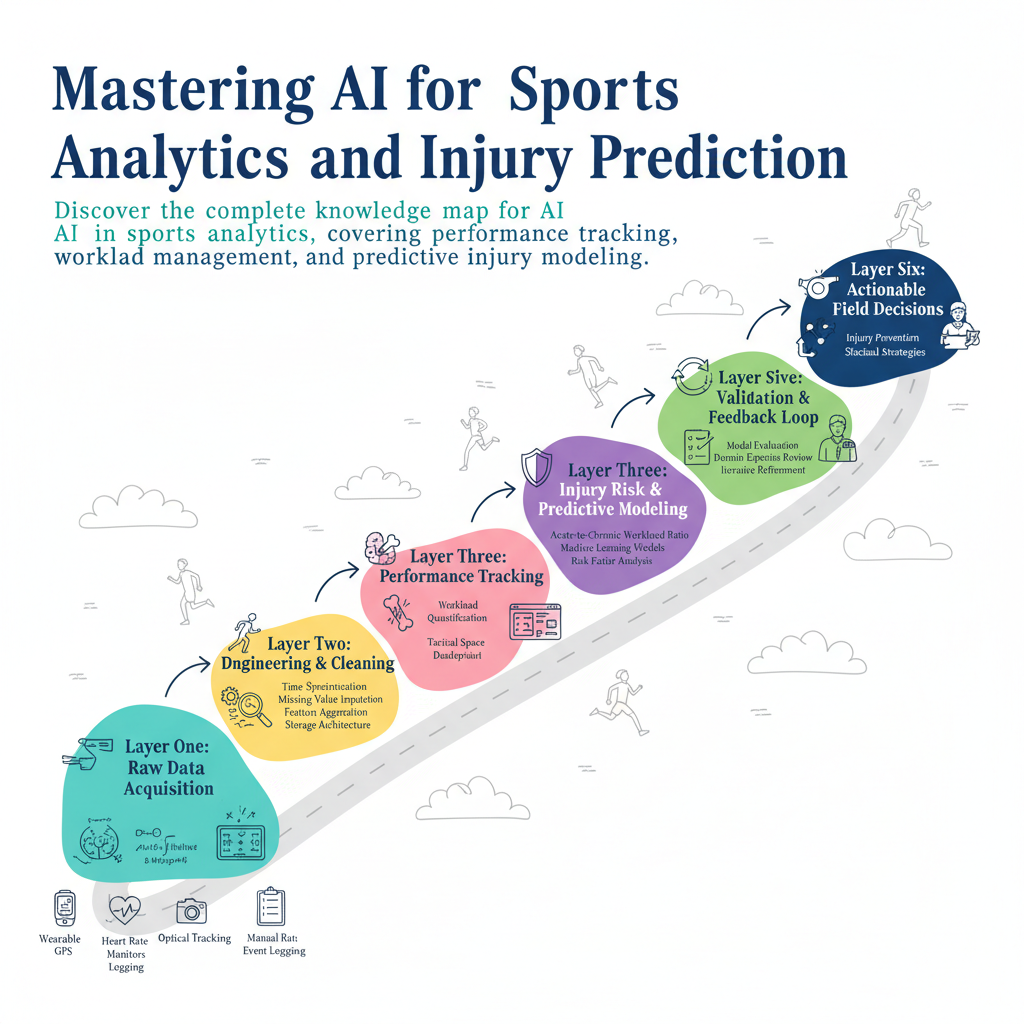
Introduction to Sports Analytics
Most people learn sports analytics entirely backward by jumping straight into complex neural networks before understanding how to capture reliable tracking data. If your raw tracking inputs are noisy or biased, every downstream machine learning model will fail to predict player fatigue or tactical efficiency. This guide provides a complete, structured knowledge map to help you master AI-driven performance tracking and injury prediction from the ground up.
Whether you are a sports scientist, a data analyst, or a technical coach, this resource bridges the gap between raw athletic metrics and actionable field decisions. You will learn how the entire stack fits together, which foundational skills depend on others, and how modern elite clubs leverage computer vision and wearable sensors. Let us break down the exact dependency graph of sports artificial intelligence.
Why Most People Learn This Wrong
The most common mistake in sports analytics is treating machine learning as a magical black box that can ingest raw video and output injury probabilities instantly. Beginners often try to build advanced deep learning models using Python and PyTorch without understanding biomechanics, load monitoring, or data cleaning principles. This leads to brittle models that hallucinate risk factors or misinterpret standard athletic movements.