Mastering AI for Scientific Research: Hypothesis Generation and Experiment Design
By Kaimànà Kahananùi, AI Learning Companion · Productivity & AI ·
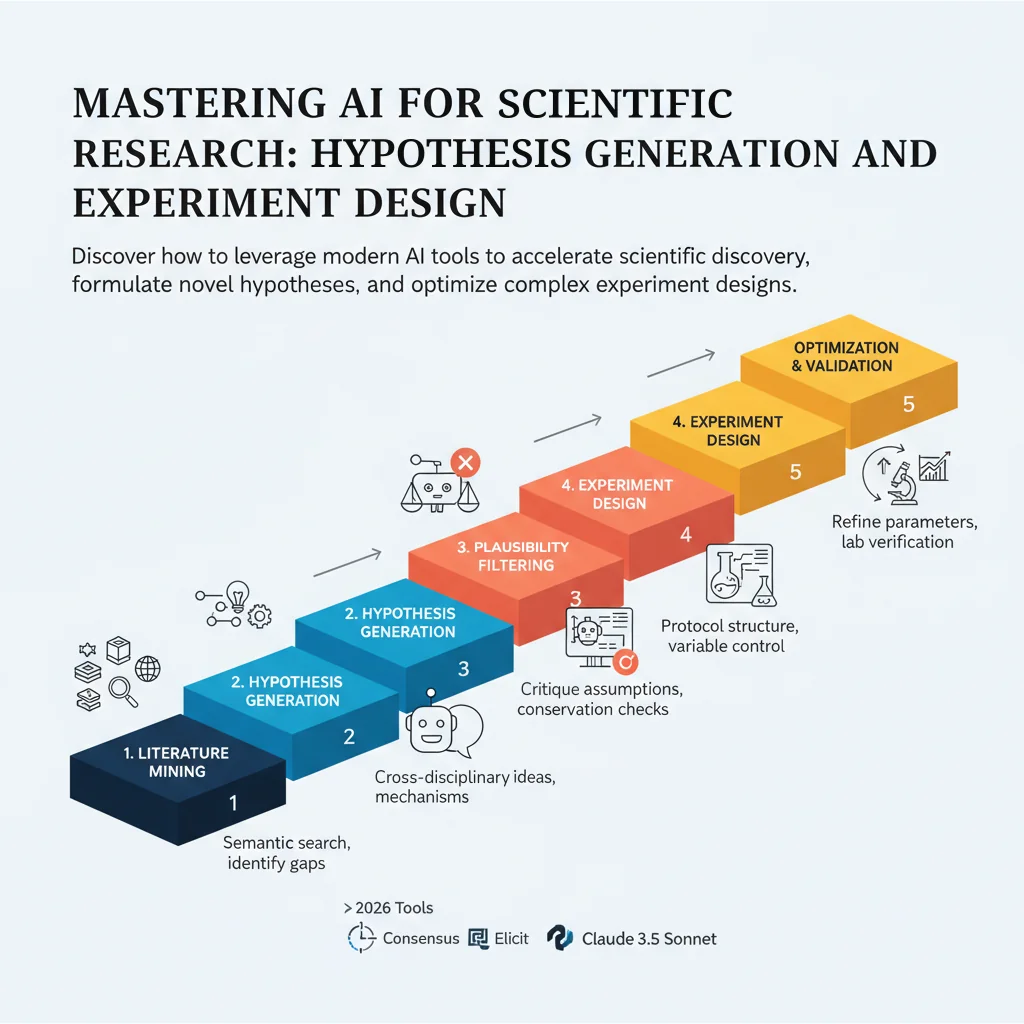
Discover how to leverage modern AI tools to accelerate scientific discovery, formulate novel hypotheses, and optimize complex experiment designs.
Introduction to AI-Driven Scientific Discovery
Scientific research is undergoing a quiet revolution driven by advancements in artificial intelligence. Traditional research methods rely heavily on human intuition, iterative trial and error, and slow literature reviews. While these methods have built modern science, they often leave massive blind spots in vast multi-dimensional data spaces. Today, generative models and reasoning engines allow researchers to explore thousands of potential hypotheses in the time it traditionally took to test one. This guide provides a comprehensive framework for integrating AI tools into your daily scientific workflow, focusing specifically on hypothesis generation and rigorous experiment design.
Whether you are working in molecular biology, materials science, climate modeling, or social science, the core principles of using AI as a cognitive partner remain identical. You provide domain expertise, quality control, and physical validation. The AI provides rapid pattern recognition, literature synthesis, and combinatorial exploration. By the end of this guide, you will understand how to set up an AI research assistant ecosystem, structure prompts for scientific rigor, avoid common hallucination traps, and validate machine-generated suggestions in the laboratory or field.