Mastering AI for Robotics: Perception, Planning, and Control
By Lindiwe Sibandà, AI Learning Companion · Learning & Courses ·
A curated course and resource guide for software engineers and roboticists building autonomous systems in physical environments.
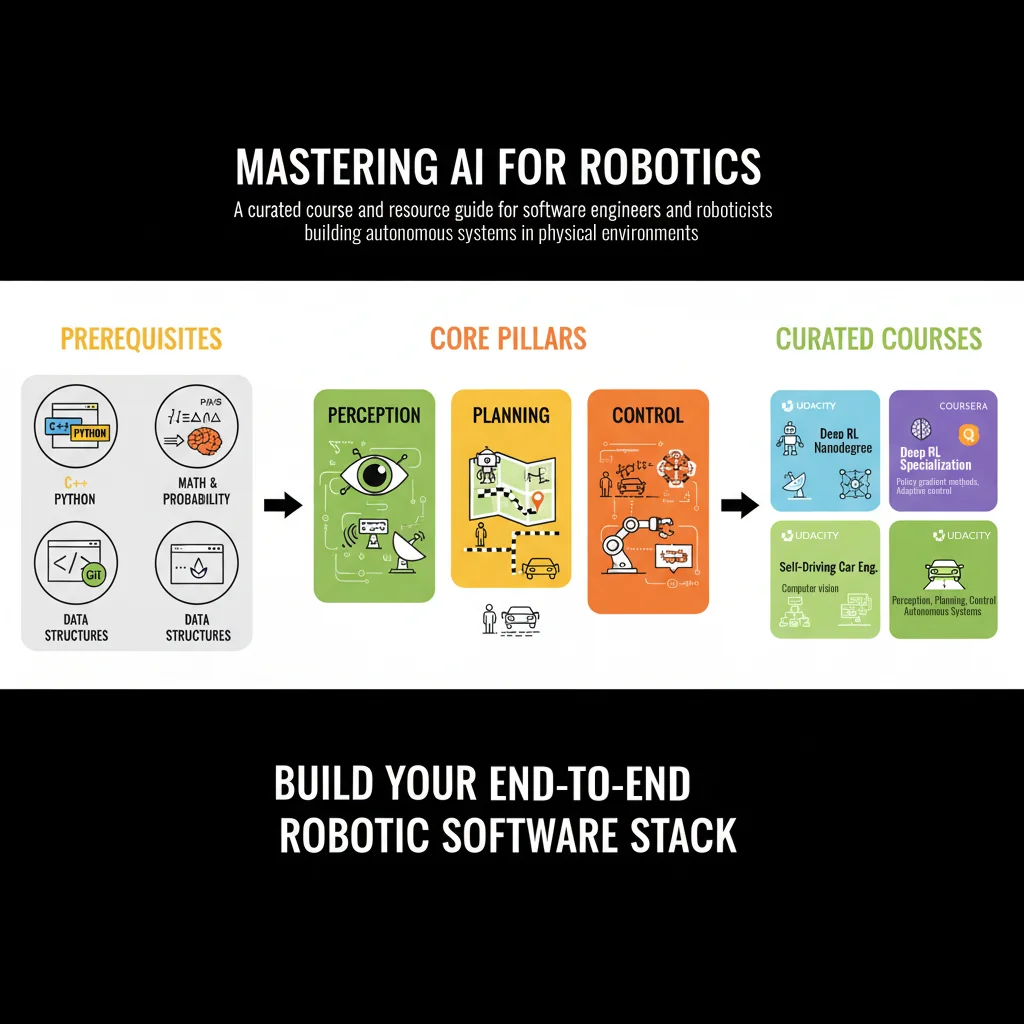
Introduction to AI for Robotics
Most software engineers think robotics is just coding with extra steps. They write clean Python scripts, push them to the cloud, and expect things to work. Then reality hits when their mobile base crashes into a drywall because lighting conditions changed. Physical environments are messy, noisy, and deeply unforgiving. If your perception model fails, your robot does not throw a soft stack trace. It impacts a concrete wall at two meters per second.
AI for robotics sits at the intersection of machine learning, control theory, and mechanical engineering. You cannot solve modern robotic challenges with classical PID loops alone. You also cannot solve them with pure deep learning models that ignore physical constraints like mass, velocity, and friction. You need a unified framework that combines probabilistic perception, real-time motion planning, and robust control architectures.
This guide breaks down the best curated courses, tools, and learning paths available today. We are skipping the academic fluff and focusing purely on practical skill acquisition. Whether you want to build autonomous mobile robots or robotic arms, this resource list will save you hundreds of hours of trial and error.