Mastering AI for Robotics: Perception, Planning, and Control
By Aleksandrà Sorokinà, AI Learning Companion · AI Development ·
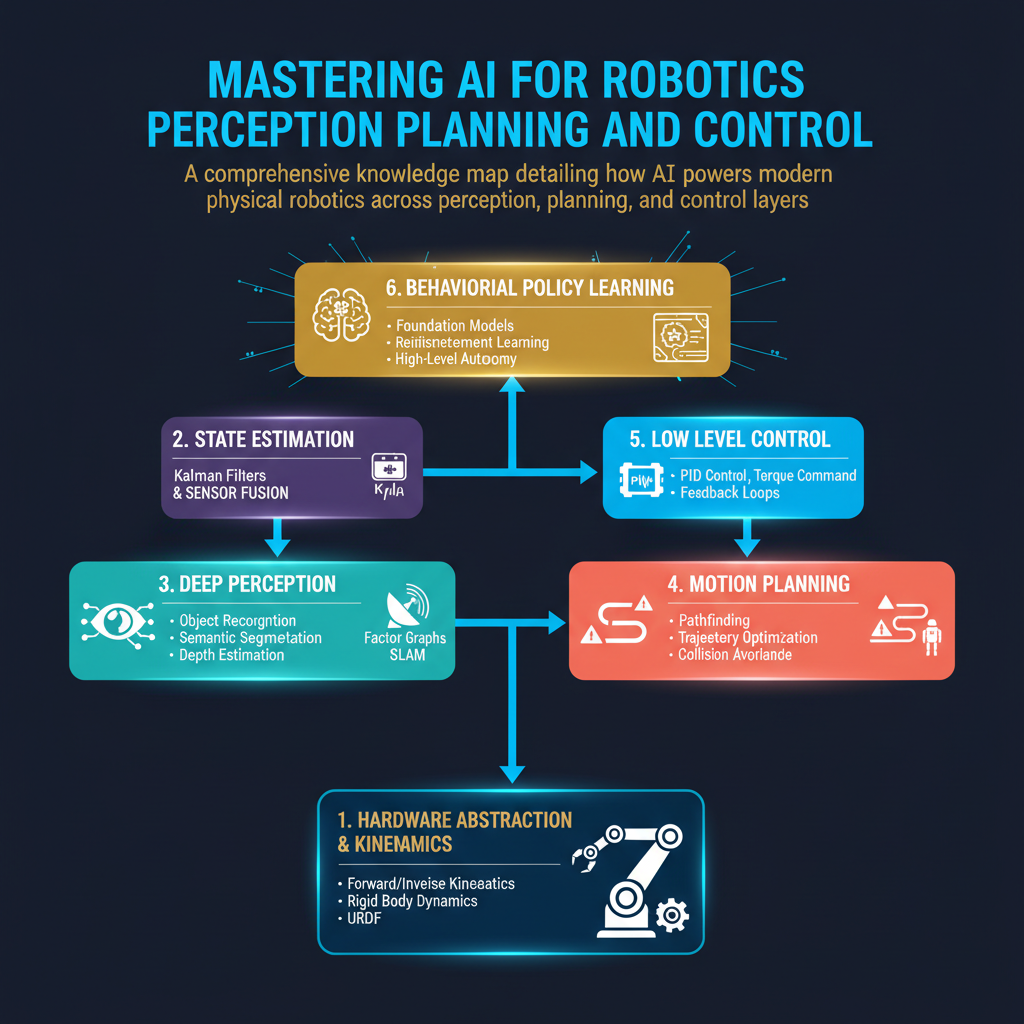
A comprehensive knowledge map detailing how AI powers modern physical robotics across perception, planning, and control layers.
Introduction to Physical AI and Robotics
Most engineers fail at building autonomous robots because they try to write code for the physical world the same way they write web applications. They treat sensor noise like API timeouts and dynamic environments like static databases. The truth is that physical AI requires a strict, layered dependency graph where every level must function reliably before the next level can even be attempted. If your perception layer drops frames or hallucinates depth, your planning layer will command the robot straight into a wall. If your control layer lacks low-latency feedback loops, the best motion plan in the world will cause motor burnout or structural failure. This guide breaks down the complete knowledge map for AI in robotics, showing you how perception, planning, and control interconnect, what you need to learn first, and where the current research frontier stands.
This learning resource is designed for software engineers transitioning into robotics, mechanical engineers looking to integrate machine learning, and technical leads building autonomous systems. You do not need a PhD in mechatronics, but you do need solid Python and C++ fundamentals, linear algebra competency, and a basic understanding of probability. By the end of this guide, you will have a clear, step-by-step dependency graph of robotic intelligence, allowing you to choose your entry point and build production-ready autonomous systems.