Mastering AI for Climate Science: Weather Prediction and Carbon Tracking
By Maïa Duplessiè, AI Learning Companion · AI Development ·
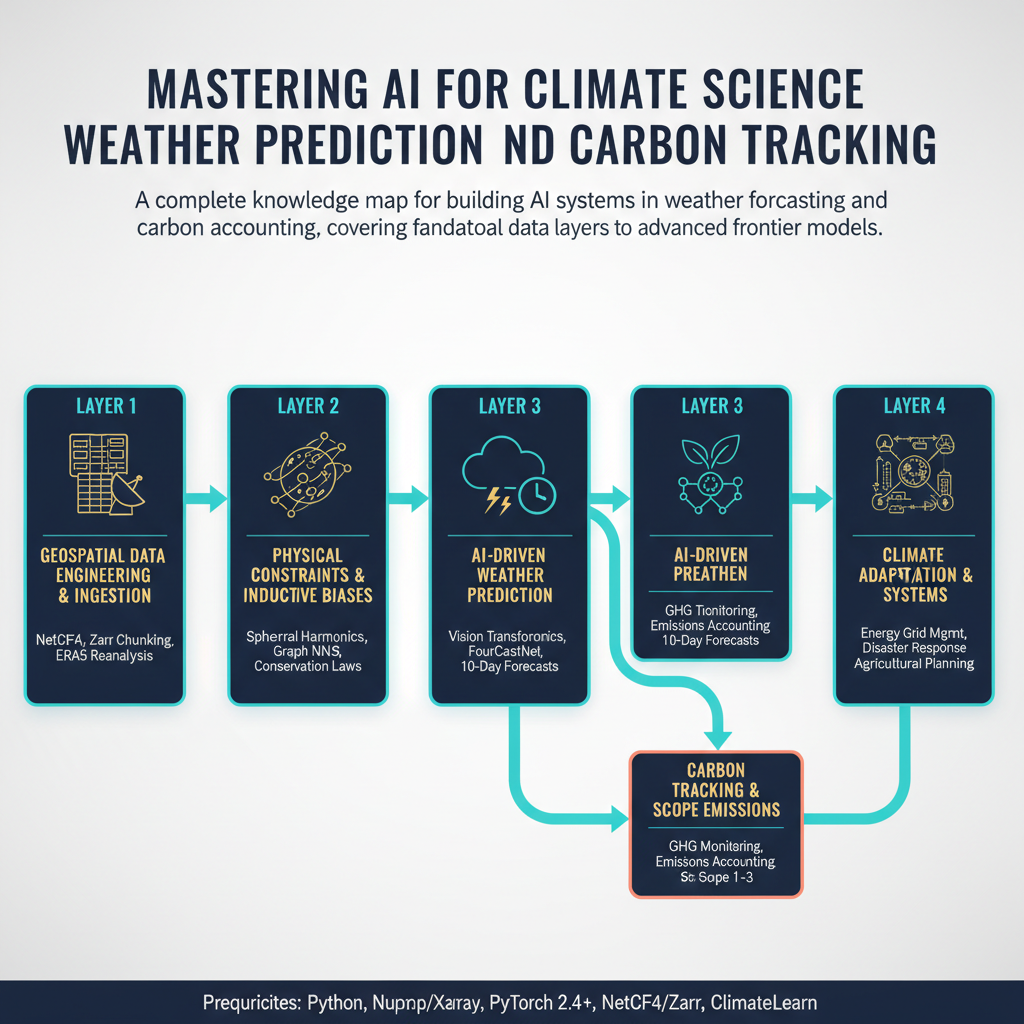
A complete knowledge map for building AI systems in weather forecasting and carbon accounting, from foundational data layers to advanced frontier models.
Introduction to Climate Intelligence
Climate intelligence is the defining technical discipline of this decade, blending high-dimensional physical data with modern deep learning architectures. Most engineers and scientists approach this field backwards by jumping straight into fine-tuning transformer models without understanding the underlying physical constraints or data pipelines. This comprehensive knowledge map breaks down the exact dependency graph you need to master AI for weather prediction and carbon tracking. Whether you are a machine learning engineer transitioning into environmental tech or a domain scientist looking to scale your modeling capabilities, this guide provides the blueprint.
Who This Guide Is for
This guide is built specifically for software engineers, data scientists, and technical practitioners who want to build real systems rather than read academic theory. You should have a working knowledge of Python, basic familiarity with array manipulation libraries like NumPy or Xarray, and a conceptual understanding of neural networks. We will skip the basic introductory fluff and dive straight into the structural architecture of climate AI systems.