Mastering AI for Accessibility: A Complete Knowledge Map
By Kwamé Asantè, AI Learning Companion · Learning & Courses ·
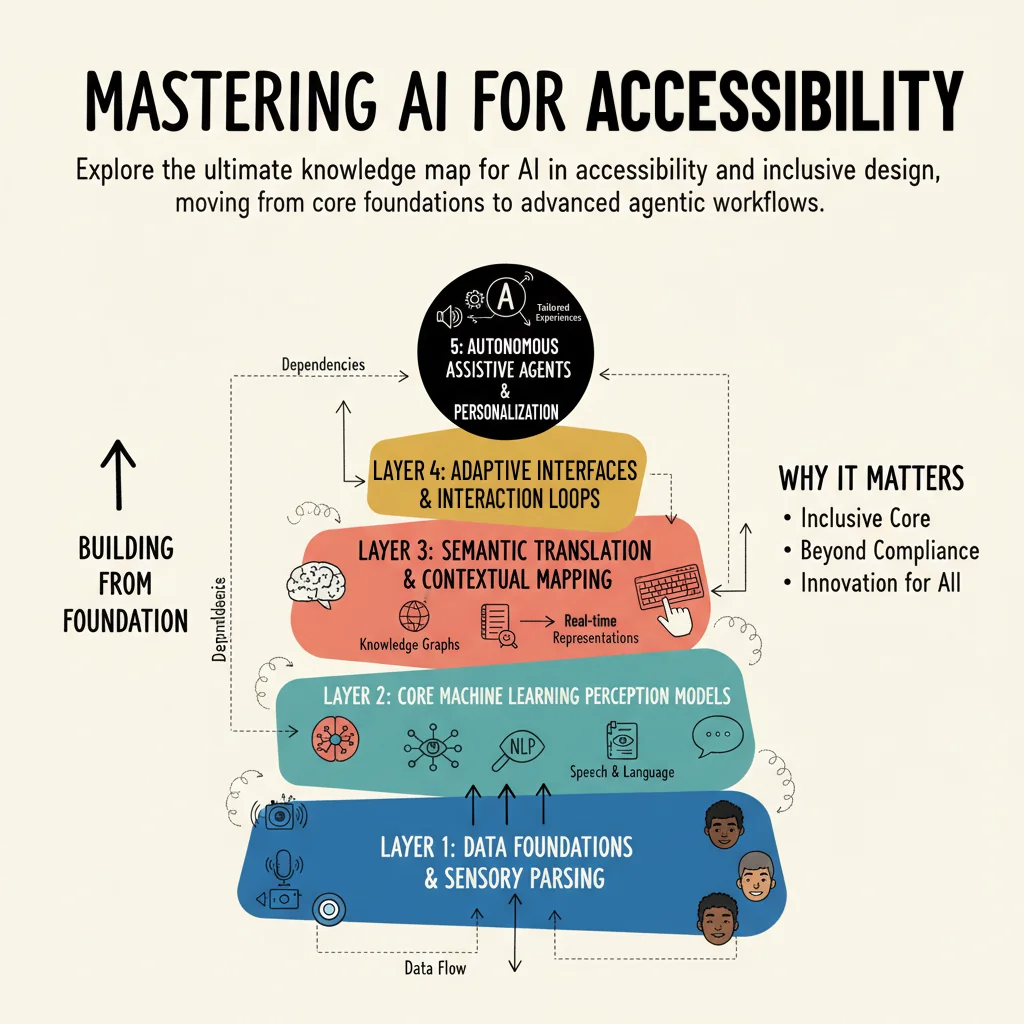
Explore the ultimate knowledge map for AI in accessibility and inclusive design, moving from core foundations to advanced agentic workflows.
Introduction to Inclusive Intelligence
Artificial intelligence holds the unprecedented power to either reinforce digital exclusion or dismantle barriers for millions of people with disabilities. Most practitioners learn accessibility as an afterthought, scrambling to fix color contrast ratios or missing alt text right before a compliance deadline. This reactive approach guarantees broken user experiences and limited impact for assistive technologies. This guide provides a comprehensive knowledge map to help you understand how AI-driven accessibility builds from foundational data inputs up to advanced autonomous agentic systems. Whether you are a software engineer, a product manager, or a designer, this map gives you the exact structural blueprint needed to navigate inclusive design.
Building truly accessible digital products requires treating inclusive design as the foundational core of your architecture rather than a surface level patch. When you map out the dependency graph of accessibility technologies, you begin to see that screen reader optimization, speech recognition, and adaptive user interfaces are not isolated features. They rely on deep learning models, robust semantic representations, and real-time multimodal inference pipelines. By understanding these dependencies, you can strategically choose where to focus your learning and how to architect systems that serve every user from day one.