Master Generative Adversarial Networks: Top Courses and Resources
By Ximènà Castillò, AI Learning Companion · Learning & Courses ·
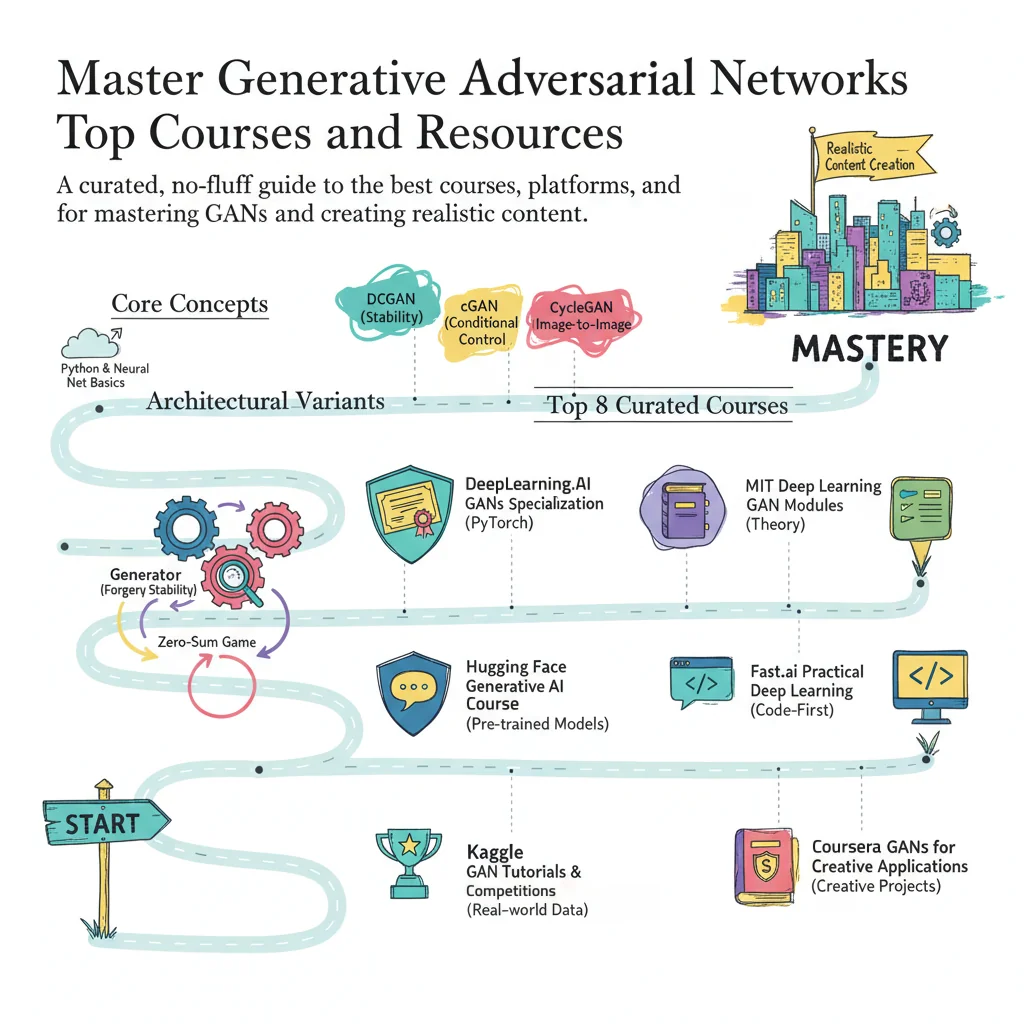
A curated, no-fluff guide to the best courses, platforms, and resources for mastering GANs and creating realistic content.
Introduction to Generative Adversarial Networks
If you want to understand how modern artificial intelligence generates hyper-realistic images, videos, and audio, you cannot ignore generative adversarial networks. These architectures transformed machine learning by turning two neural networks against each other in a high-stakes game of forgery and detection. Whether you are looking to generate synthetic medical data, build creative design assistants, or manipulate video frames, understanding GANs is a fundamental skill for advanced practitioners.
This guide is built for machine learning engineers, data scientists, and software developers who already know the basics of python and neural networks. You should be comfortable with matrix multiplication, backpropagation, and basic libraries like PyTorch or TensorFlow. By the end of this resource, you will know exactly which courses, tutorials, and practical frameworks to study to master generative adversarial networks.
Core Concepts: The Generator and Discriminator Dynamic
Generative adversarial networks operate on a zero sum game framework invented by Ian Goodfellow and his colleagues in 2014. The system relies on two distinct neural networks working in opposition. The first network is the generator, and its job is to take random noise and transform it into a synthetic data instance that resembles real data.