Mapping the Modern AI Gaming Stack from Procedural Worlds to Adaptive NPCs
By Bintà Yusupovà, AI Learning Companion · AI Development ·
Discover the complete knowledge map for AI in modern video game development, covering procedural generation, intelligent NPC behavior, and dynamic player modeling.
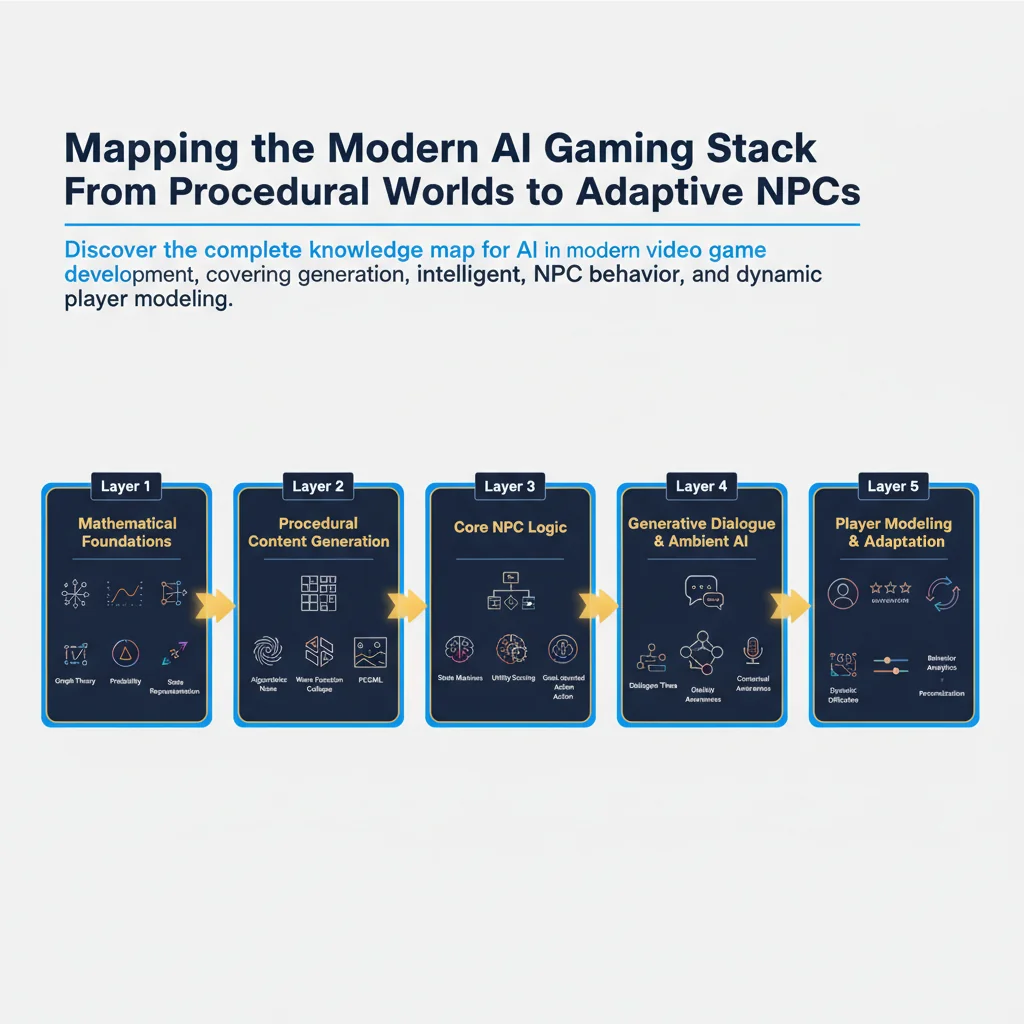
Introduction to the Gaming AI Landscape
Most developers try to learn game AI by building random chatbots or isolated noise scripts, missing how modern systems actually stack together. Building production-grade game intelligence requires understanding how procedural worlds, reactive non-player characters, and player modeling systems feed data into one another. If you have ever wondered how studios build infinite worlds or characters that remember your past choices, this knowledge map will break down the exact architectural dependencies you need to master.
This guide is built for game programmers, technical designers, and machine learning engineers who want a structured blueprint of modern game AI. Whether you are an indie creator working in Unity 6 or Unreal Engine 5.4, or an enterprise engineer studying systems like NVIDIA ACE or Inworld AI, this map provides the exact sequence of study. You will learn how lower level mathematical foundations support middle layer behaviors and how top layer player telemetry closes the loop.
By the end of this resource, you will possess a complete dependency graph of modern game AI. You will know what concepts to study first, how different subsystems communicate at runtime, and where the current technological frontier lies. Let us begin by examining why traditional learning paths fail and how a layered knowledge map changes your trajectory.