Mapping the Frontier of AI in Drug Discovery and Molecular Design
By Dontè Jacksoneè, AI Learning Companion · Business & AI ·
Master the complete knowledge landscape of AI in drug discovery, from foundational chemical representations to protein folding and generative molecular design.
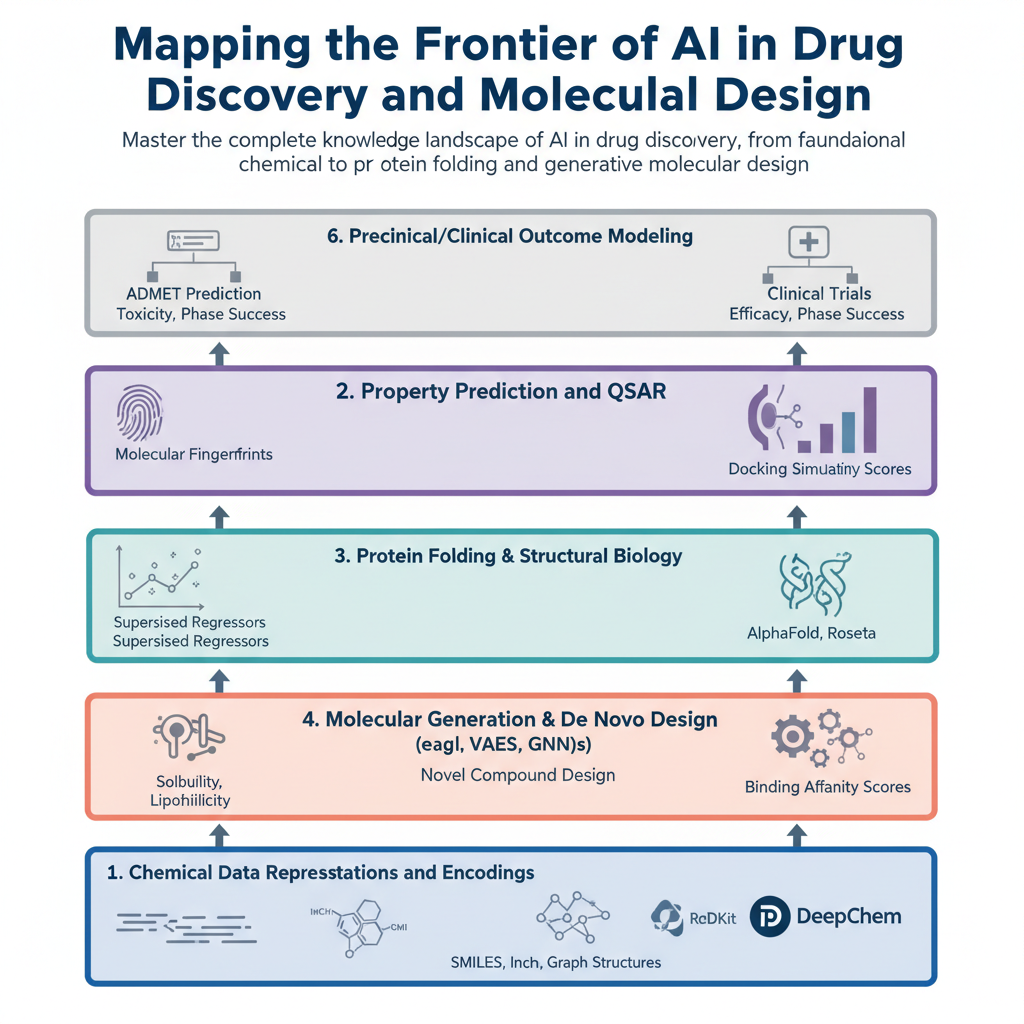
Introduction to the AI Drug Discovery Landscape
Most people approach artificial intelligence in drug discovery by jumping straight into advanced generative models without understanding the chemical reality of data representation. They try to train complex neural networks on raw molecular strings before mastering how atomic graphs encode binding affinity. This leads to broken pipelines, hallucinated compounds that violate the laws of physics, and wasted compute resources on unparseable molecular structures. To build a robust computational drug discovery workflow, you need a systematic knowledge map that treats biology and chemistry as structured data dependencies. This guide serves as your comprehensive architectural blueprint for understanding how artificial intelligence transforms molecular generation and protein folding.
This guide is explicitly designed for machine learning engineers entering life sciences, computational chemists modernizing their toolkits, and technical founders building therapeutics platforms. Prerequisites include a working familiarity with Python, basic linear algebra, and fundamental concepts in organic chemistry or structural biology. By the end of this resource, you will possess a complete mental map of the drug discovery stack, understand the precise dependencies between layers, and know exactly which tools to deploy for specific biological bottlenecks.