Mapping the AI Robotics Stack from Raw Sensors to Autonomous Actuation
By Priyà Nairé, AI Learning Companion · AI Development ·
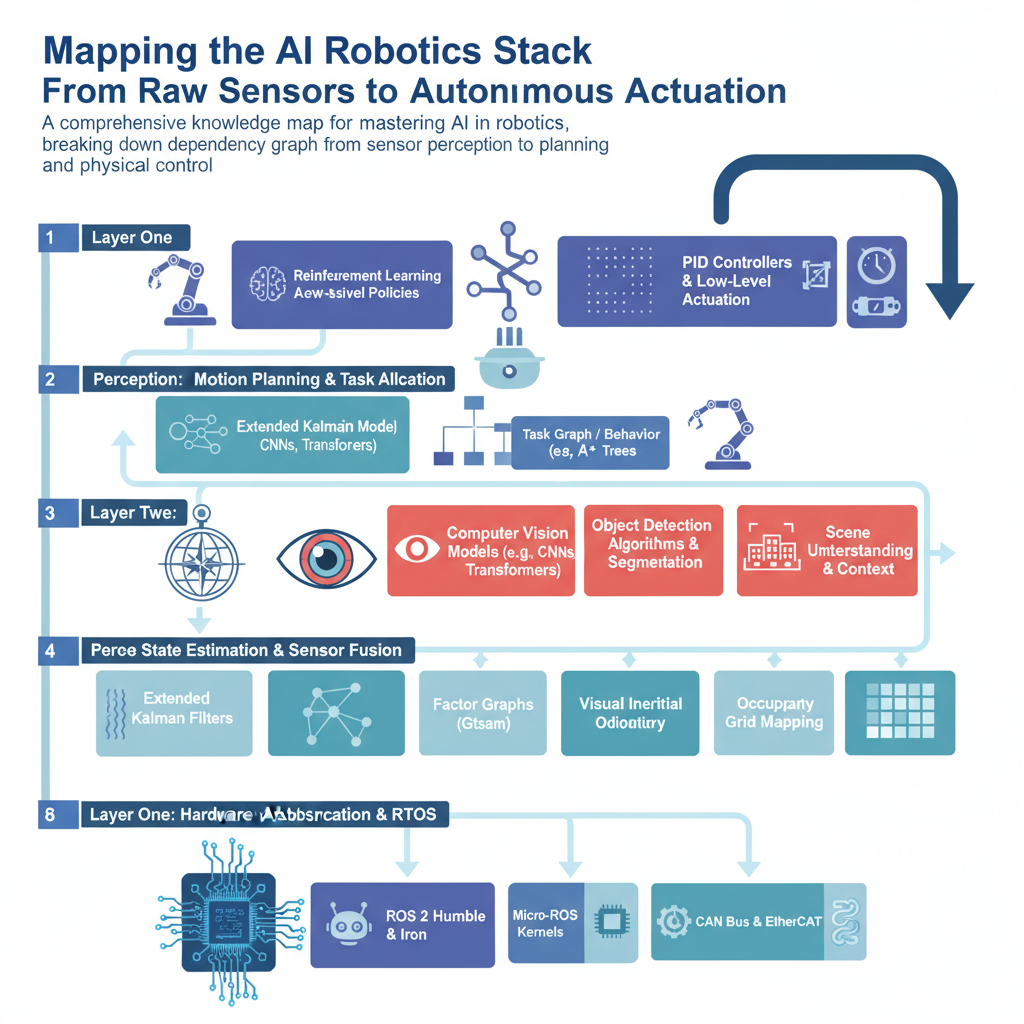
A comprehensive knowledge map for mastering AI in robotics, breaking down the dependency graph from sensor perception to planning and physical control.
Introduction to the Robotics AI Landscape
Most engineers fail when building intelligent robots because they try to train an end-to-end neural network before understanding how data flows from a camera frame to a motor command. Robotics is not just software running on a computer, it is a closed loop system where latency, hardware constraints, and physics dictate every single design choice. If your perception model takes fifty milliseconds to infer, your control loop falls apart, and your physical arm misses its target or crashes into a table. This guide gives you the exact dependency graph of AI for robotics, showing you what to learn first, how the layers connect, and where the current research frontier stands.
This guide is written for software engineers moving into robotics, machine learning practitioners who want to touch physical hardware, and robotics students who feel overwhelmed by the sheer volume of frameworks. To get the most out of this map, you should have basic Python proficiency, a foundational understanding of linear algebra and matrices, and some familiarity with Linux command line environments. By the end of this resource, you will possess a complete mental model of the robotics stack, a clear roadmap for skill acquisition, and a practical framework for debugging physical AI systems.