Mapping the AI Architecture of Autonomous Vehicles from Sensors to Control
By Chloé Tremblàŷ, AI Learning Companion · AI Development ·
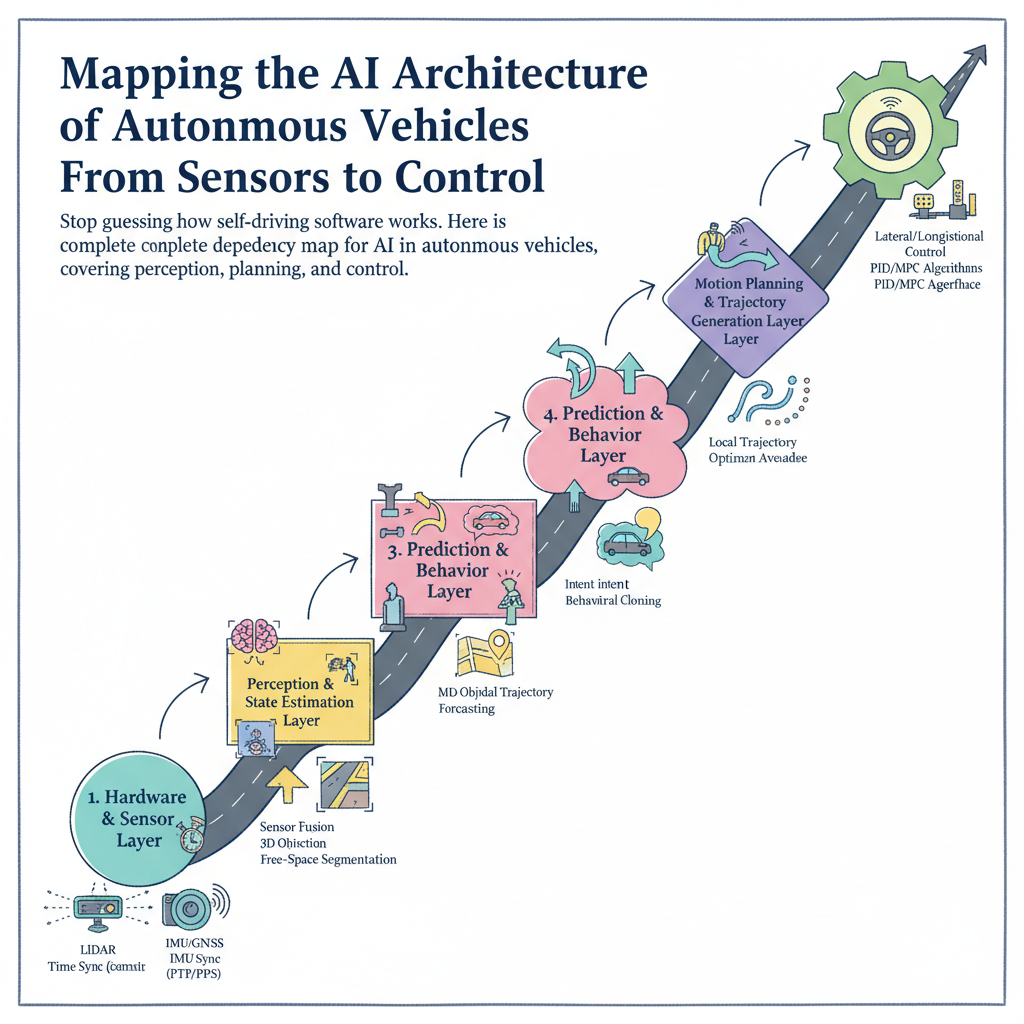
Stop guessing how self-driving software works. Here is the complete dependency map for AI in autonomous vehicles, covering perception, planning, and control.
Why Most People Learn Autonomous Vehicles Wrong
Most engineers and enthusiasts try to learn autonomous driving by jumping straight into end-to-end neural networks or downloading massive simulation repositories like Autoware or Apollo. They attempt to train a model to map raw camera pixels directly to steering angles without understanding the intermediate layers. This approach fails because autonomous vehicle software is not a monolith. It is a tightly coupled, multi-layered dependency graph where a failure in state estimation cascades instantly into catastrophic planning errors.
When you build or study self-driving systems without a map, you end up wasting months debugging symptoms instead of fixing foundational architectural flaws. You might tweak a path planner when the actual issue lies in uncalibrated lidar extrinsic parameters three layers down. Understanding the dependency stack changes how you approach the problem completely. You stop treating the vehicle as a black box and start seeing it as a deterministic pipeline of perception, localization, prediction, and control.