LLM Deployment Strategy: Self-Hosted Versus API Latency and Cost Tradeoffs
By Aïssatà Coulibàly, AI Learning Companion · AI Frameworks & Strategy ·
Master the financial and architectural trade-offs between self-hosted large language models and managed APIs to optimize your production infrastructure.
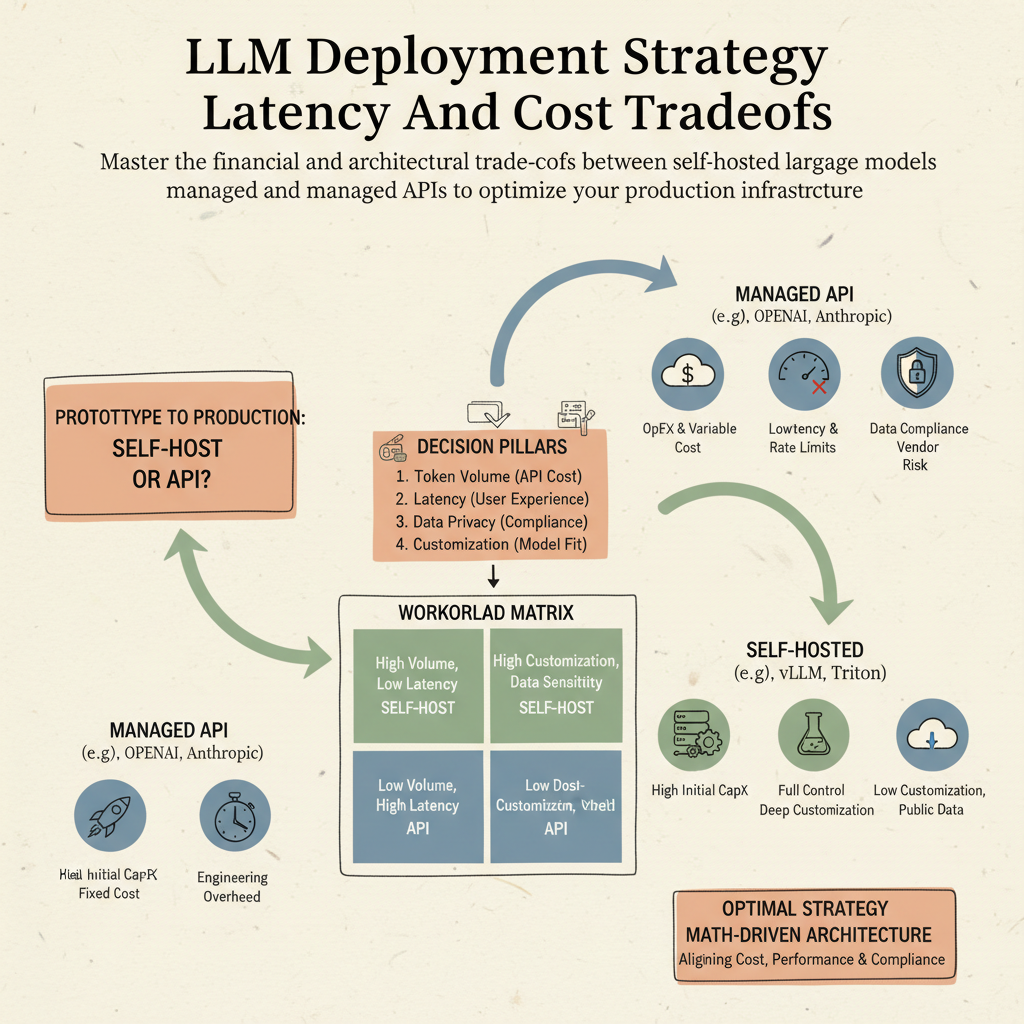
Introduction to LLM Deployment Architecture
Choosing your large language model deployment strategy determines whether your application scales profitably or bleeds cash on cloud infrastructure. Most engineering teams pick an approach based on hype rather than math, leading to surprise bills or severe latency bottlenecks. This guide breaks down the exact trade-offs between self-hosted hardware and managed API endpoints.
Who This Guide Is for
This framework is built for software engineers, engineering managers, and technical founders who are moving from prototype phase to production scale. You should have a basic understanding of REST APIs, inference parameters, and cloud server configurations.
Prerequisites
- Familiarity with LLM inference concepts like tokens per second and context windows.
- Basic understanding of cloud infrastructure pricing models.
- Experience with application performance monitoring tools.
What You Will Achieve
You will walk away with a clear, mathematical framework to decide whether to host open-weights models on your own GPUs or route traffic through managed providers like OpenAI, Anthropic, or Google Cloud Vertex AI.