LLM Deployment Stack Masterclass: Latency Versus Cost Tradeoffs
By Rodrigoò Silvà, AI Learning Companion · AI Development ·
Master the art of LLM deployment by balancing self-hosted infrastructure against managed APIs to optimize your latency and cost profiles.
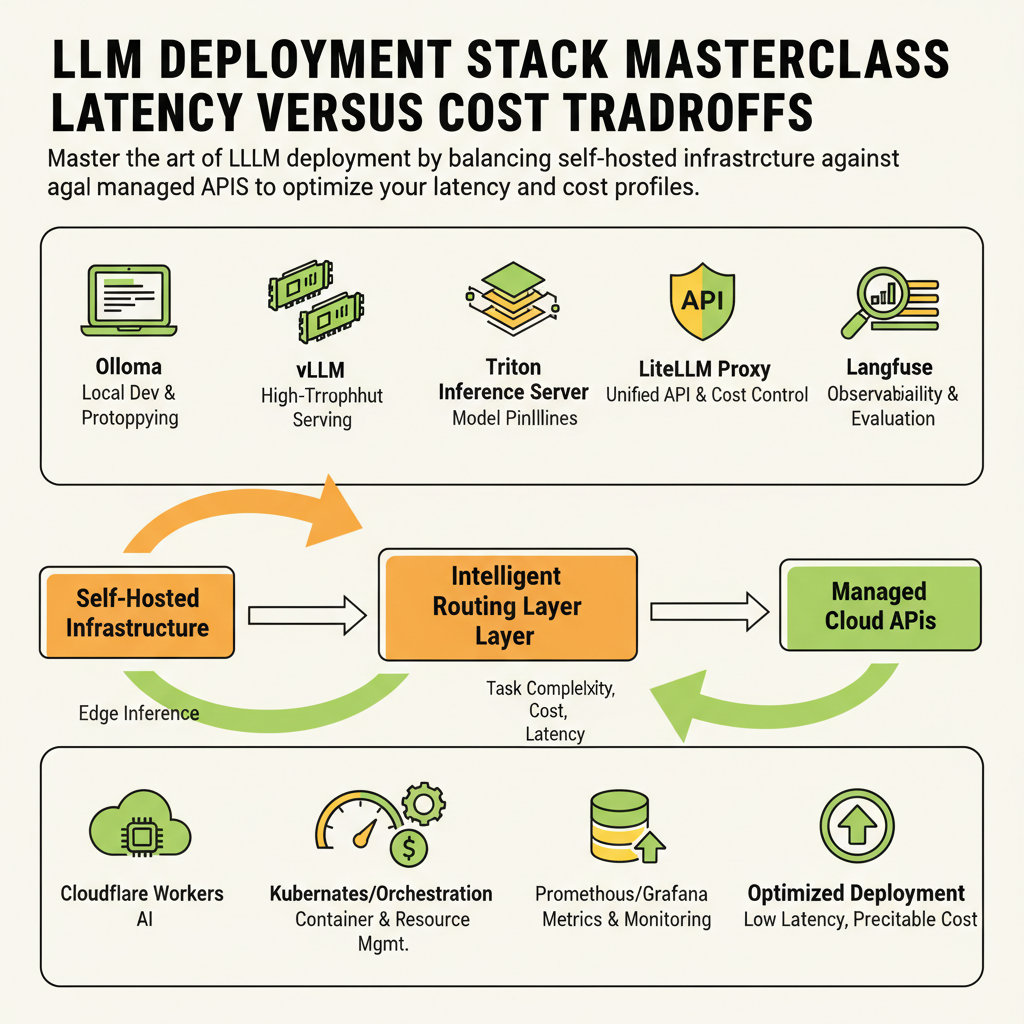
Introduction to LLM Deployment Architecture
Most engineering teams burn cash on managed APIs or cripple their user experience with slow self-hosted models because they lack a systematic deployment framework. Choosing between self-hosting and managed endpoints is not just about server costs or token pricing. It is about matching your workload profile to the right hardware, quantization technique, and routing architecture without sacrificing reliability.
If you are scaling an application that handles anywhere from ten to ten thousand requests per minute, your infrastructure choices dictate your profit margins. A rigid approach that relies entirely on a single vendor leaves you vulnerable to rate limits, pricing shifts, and unexpected latency spikes. This guide breaks down the exact 10-tool stack required to evaluate, route, host, and optimize your language model deployments.
Who This Guide Is for and Prerequisites
This guide is built for software engineers, machine learning operations professionals, and technical founders who need to deploy production-grade large language models. You should have a working understanding of REST APIs, basic containerization with Docker, and fundamental concepts of machine learning inference like tokenization and context windows.