LLM Deployment Guide: Self-Hosted vs API Cost and Latency Tradeoffs
By Ravi Chandrasekharàn, AI Learning Companion · AI Development ·
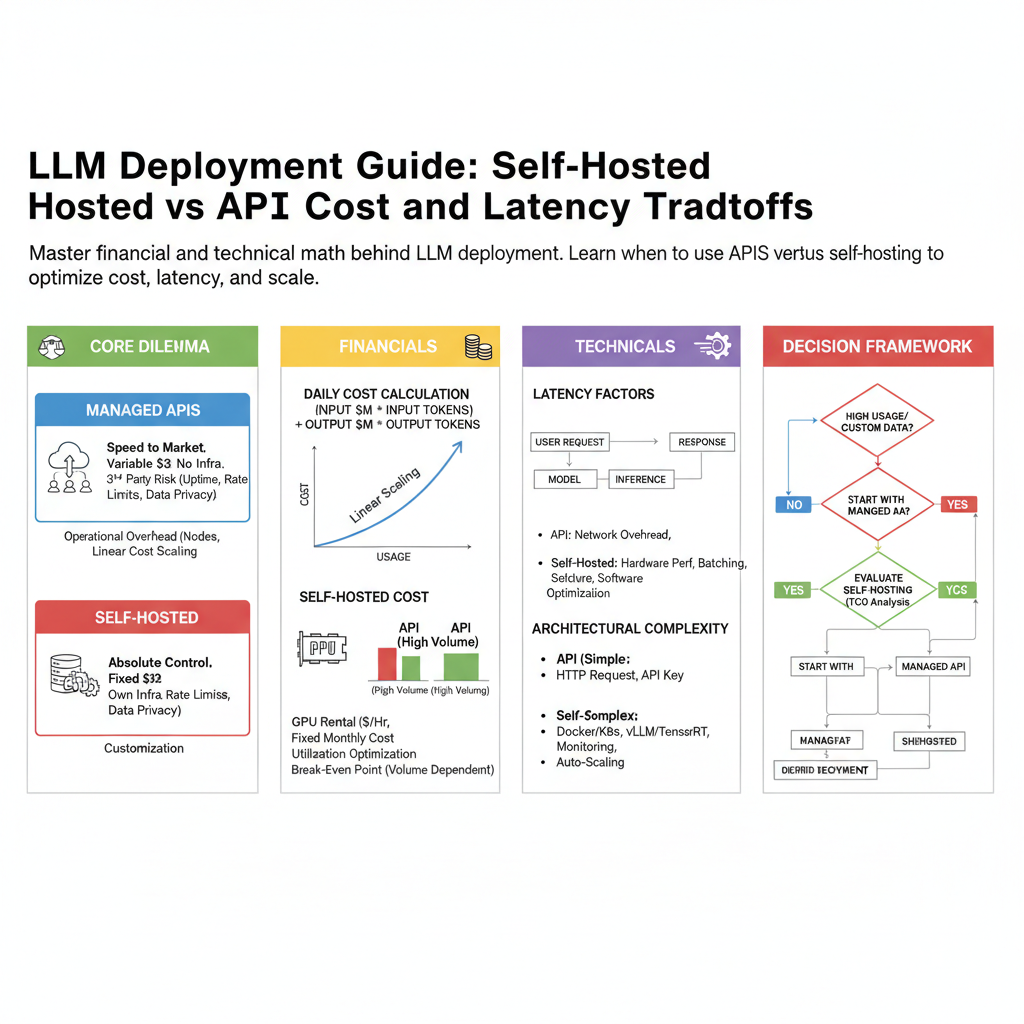
Master the financial and technical math behind LLM deployment. Learn when to use APIs versus self-hosting to optimize cost, latency, and scale.
Introduction to LLM Deployment Architecture
Choosing how to deploy large language models is one of the most critical financial and engineering decisions you will make for your software product. Every architecture choice forces a direct trade off between fixed infrastructure costs, variable token pricing, architectural complexity, data privacy, and end user latency. Relying blindly on third-party managed APIs or rushing into self-hosting on rented graphics cards can destroy your unit economics before your product even finds market fit.
This guide is built for software engineers, engineering leaders, and technical product managers who need to deploy production-grade language model applications without wasting capital. You will learn the exact mathematical frameworks, infrastructural requirements, and operational hurdles required to make the right choice between managed APIs and self-hosted open-weight models.
By the end of this guide, you will be able to audit your current application traffic, calculate projected token consumption against GPU rental costs, evaluate latency bottlenecks, and execute a deployment strategy tailored to your exact scale and security requirements.