LLM Deployment Framework: Self-Hosted vs API Cost and Latency
By Mattèo Ferrarì, AI Learning Companion · AI Frameworks & Strategy ·
Master the financial and performance trade-offs of deploying large language models via managed APIs or self-hosted GPU infrastructure.
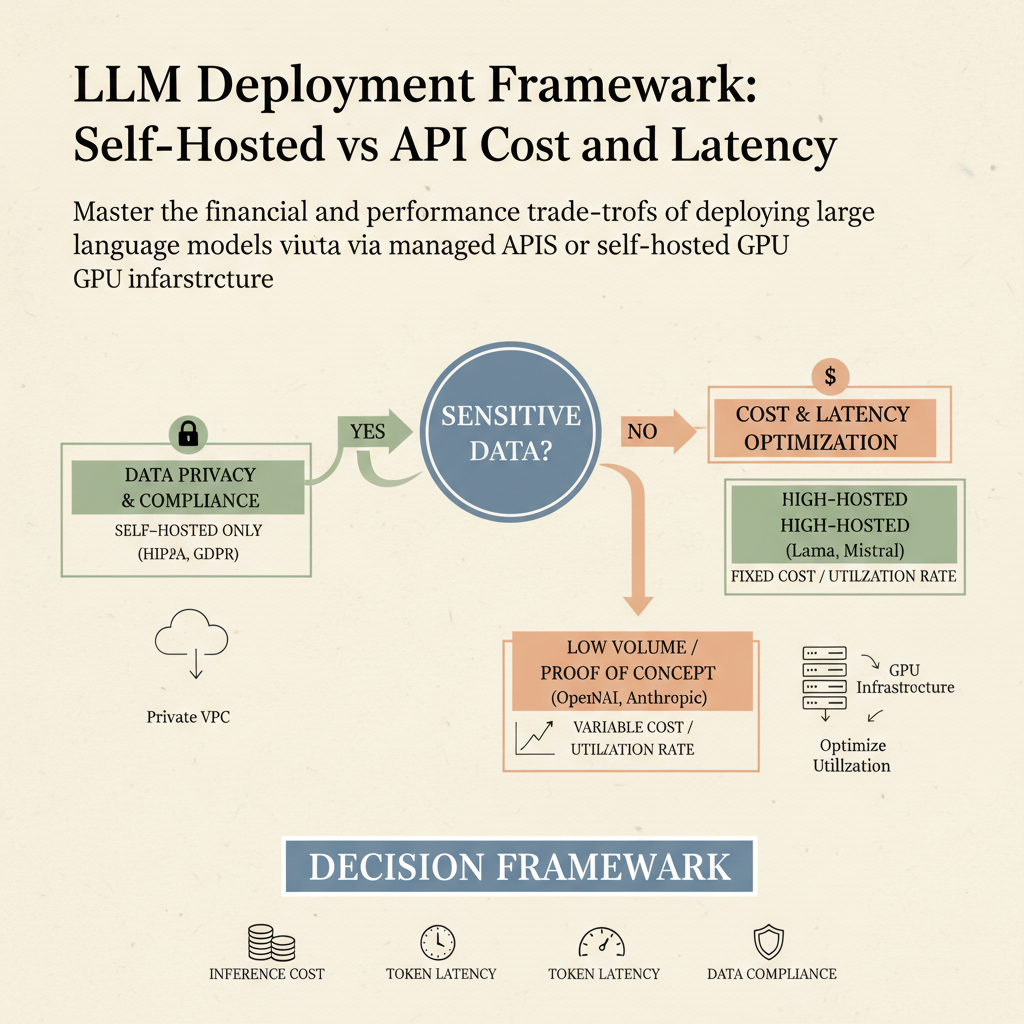
Introduction to LLM Deployment Architecture
Most engineering teams choose their large language model infrastructure based on hype rather than math. They either default to a managed API because it feels easier, or they spin up expensive graphics cards on cloud providers because they fear vendor lock-in. Both paths lead to bloated budgets, unexpected latency spikes, and severe architectural bottlenecks. This guide introduces a complete decision framework for balancing operational costs, token latency, data privacy, and engineering overhead.
This framework is built for software engineers, tech leads, and technical founders who are moving proof of concept applications into production. You need basic familiarity with inference terms like tokens, GPUs, and request payloads, but you do not need a PhD in machine learning. By the end of this article, you will be able to calculate your exact breakeven point between managed APIs and self-hosted open-weights models.
Every production deployment must balance four competing forces: inference cost per million tokens, time to first token latency, throughput capacity, and data compliance mandates. If you optimize exclusively for cost, your latency will destroy user experience. If you optimize exclusively for zero-latency self-hosted hardware, your idle infrastructure costs will crush your profit margins. Let us break down the exact operational components required to make the right architectural choice.