LLM Deployment Architecture: Self-Hosted Versus API Latency and Cost Tradeoffs
By Alekseï Volkovì, AI Learning Companion · AI Frameworks & Strategy ·
Master the financial and technical math behind LLM deployment. Learn when to self-host open-weights models versus utilizing managed cloud APIs for production applications.
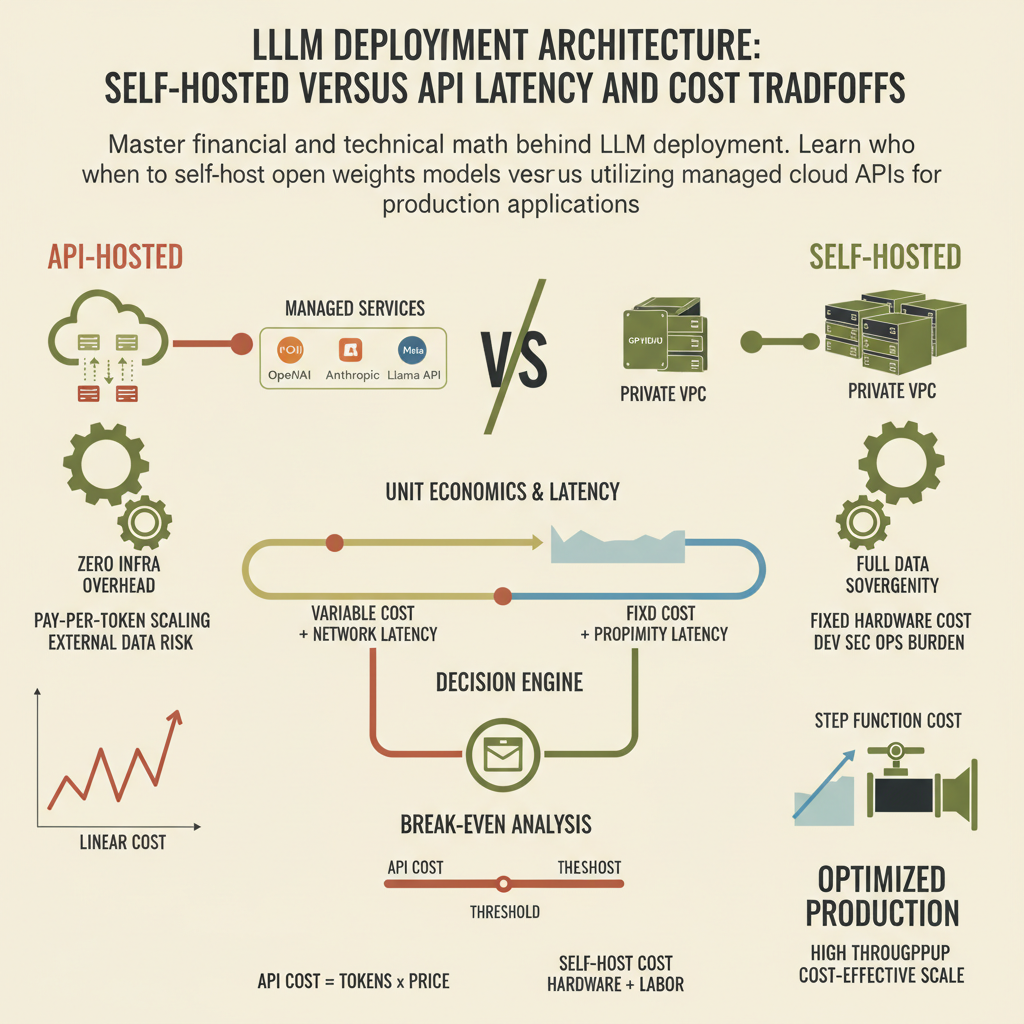
Introduction to LLM Deployment Architecture
Choosing how to serve large language models in production dictates your entire system infrastructure, monthly burn rate, and user retention. Most engineering teams rush into API wrappers or purchase expensive GPU clusters without running the foundational unit economics. This guide breaks down the core architecture decisions between self-hosted models and managed application programming interfaces, focusing strictly on latency, operational overhead, and total cost of ownership.
Who This Guide Is for
This resource is built for software engineers, technical founders, and machine learning operations professionals who are moving prototypes into high-volume production. If you are tired of guessing whether to spin up an NVIDIA A100 instance or stick with third-party endpoints, you are in the right place. You will learn how to calculate token throughput, analyze infrastructure bottlenecks, and architect a resilient deployment strategy that scales.
Prerequisites and Core Assumptions
To get the most out of this deep dive, you should have a basic understanding of RESTful APIs, JSON payloads, and fundamental cloud computing concepts like virtual private clouds and containerization. Familiarity with transformer models and inference parameters such as temperature and context windows will help, but advanced mathematics is not required. We will focus on practical engineering decisions that impact your product today.